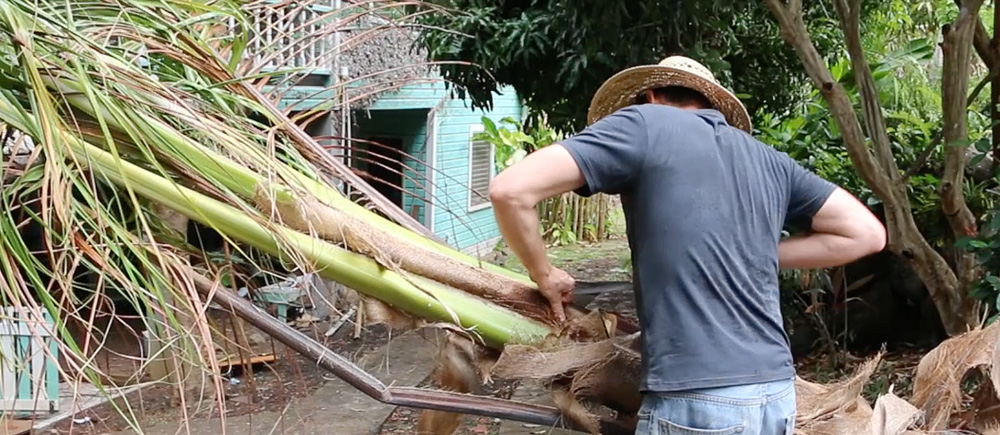
After much scientific chopping with a machete, I believe this tree was dying from lethal yellowing.
There are weevils that lay eggs in the center of palm trees, then the developing larvae tunnel the tree to death. In this case, there were no weevils. The symptoms also look to me like the dreaded lethal yellowing.
Lethal Yellowing
Lethal yellowing is a disease of palms which swept through South Florida decades ago and took out many of the iconic palms lining roads and parks.
According to Infogalactic:
“There is a direct connection between green lawns and the spread of lethal yellowing in Florida. Even so-called ‘resistant cultivars’ such as the Malayan Dwarf or the Maypan hybrid between that dwarf and the Panama Tall were never claimed to have a 100% immunity.The nymphs of the planthoppers develop on roots of grasses, hence the areas of grass in the vicinity of palm trees is connected with the spread of this phytoplasma disease. The problem arose as a direct result of using coconut and date palms for ornamental and landscaping purposes in lawns, golf courses and gardens together with these grasses. When these two important food palms were grown in traditional ways (without grasses) in plantations and along the shores, the palm groves weren’t noticeably affected by lethal yellowing. There is no evidence that disease can be spread when instruments used to cut an infected palm are then used to cut or trim a healthy one. Seed transmission has never been demonstrated, although the phytoplasma can be found in coconut seednuts, but phytosanitary quarantine procedures that prevent movement of coconut seed, seedlings and mature palms out of an LY epidemic area should be applied to grasses and other plants that may be carrying infected vectors.”
See – there’s another reason not to keep your yard nice!
The symptoms exhibited by this unfortunately coconut palm mesh with what I read at UF about lethal yellowing disease:
“As foliage discoloration advances up through the crown (canopy), the spear (youngest) leaf collapses and hangs down in the crown. This indicates the apical meristem (bud or growing point of the palm) has died.
For most palm species, including coconuts, death of the apical meristem usually occurs when one-half to two-thirds of the crown has become yellow or brown. However, for Phoenix species and Borassus flabellifer, spear leaf collapse and death of the apical meristem occurs when one-third or less of the crown has become discolored (Figure 15). For Adonidia and Veitchia, the spear is usually unaffected until after all other leaves have died.
Once this spear leaf breaks off or falls from the crown, it is not readily apparent that the apical meristem (bud) has died.
Eventually, the entire crown of the palm withers and topples, leaving a bare trunk standing. Infected palms usually die within 3 to 5 months after the first appearance of symptoms.”
Yep. That’s what happens.
How I Plan to Deal with Lethal Yellowing
Unfortunately, there’s not a foolproof cure for the disease. UF admits as much, even in giving a treatment plan:
“Chemical control of LY is achieved by application of the antibiotic oxytetracycline HCl (often referred to as OTC) administered to palms by liquid injection into the trunk
As a therapeutic measure, systemic treatment on a 4-month treatment schedule should begin as early in symptom expression as possible. Symptomatic palms with >25% discolored leaves should be removed, since they are unlikely to respond to OTC treatment. For susceptible Phoenix species, if the apical meristem (bud) is already dead, the palm will not respond to OTC treatment.
The antibiotic can also be used preventively to protect palms when LY is known to occur in the area. The amount recommended depends on the size of the treated palm. Always follow directions for use on the label.
The one question often asked regarding OTC injections concerns the length of time one must continue to inject. Unfortunately, there is no definitive answer. The antibiotic does not necessarily kill the phytoplasma but simply reduces or suppresses the phytoplasma population in the palm to a level that is no longer harmful, allowing resumption of normal growth of the palm. If injections are stopped, it is possible the phytoplasma will begin to increase once again and symptoms will reappear on the palm. Alternatively, if the disease is still active in the area, the unprotected palm could be re-infected with the phytoplasma.
Disease management via control of planthopper populations is insufficient to justify repeated insecticide applications in landscapes. Planthoppers are flying insects, and they also can be blown around by wind.
Use of host palm resistance represents the most practical long-term solution for LY control.”
There are varieties here in Central America that are being tested for lethal yellowing resistance.
For now, I am cutting down infected specimens…
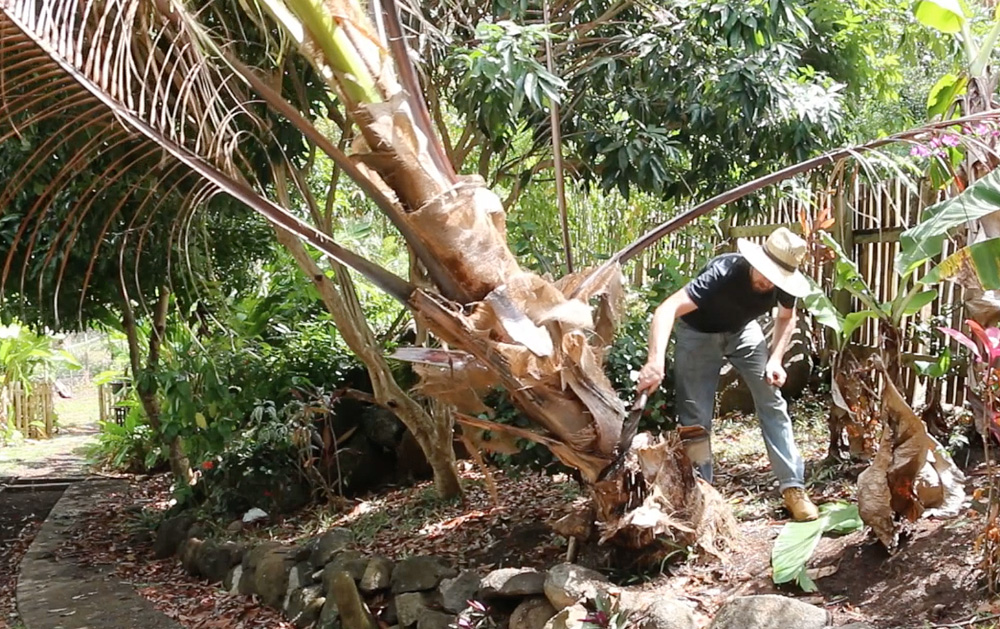
…and I am planting more coconuts around this property. Coconuts out in the wild and on the beaches don’t seem to be dying all that much, even as the ones around houses are.
Hollywood Blvd in Hollywood, Florida, used to be lined with Jamaican King palm trees – a large, beautiful coconut palm.
Lethal yellowing killed many of them and then, in 1989, the news went out that the trees would be replaced with a hybrid royal palm:
“On Wednesday, city commissioners agreed to spend $247,000 to plant 233 Maypan palms on the beach and 30 royal palms on Hollywood Boulevard.
“If we`re going to have a Hollywood, we`ve got to have royal palms on Hollywood Boulevard,“ City Commissioner John Williams said.
Hundreds of Jamaican tall coconut palms already are planted on the beach, and about 200 royal palms line Hollywood Boulevard from Young Circle to the Intracoastal Waterway.
But some of the existing trees have been harmed by fungus and lethal yellowing disease, as well as improper pruning by city employees, said Jerry Behrmann, who owns Key Lime Landscape Nursery and was hired to plant the new palms.
Behrmann said he expected to begin the beach plantings within two weeks, but was not sure how soon the trees would be planted on the boulevard.
The Maypans, a hybrid created to resist lethal yellowing, will stand about 20 feet high, or about 10 feet shorter than the Jamaican talls on the beach. The new royal palms, about 20 feet tall, will be dwarfed by the old 60- to 70-foot palms that dot the boulevard.”
The Boulevard is beautiful now thanks to those palms, but I can imagine how much more tropical it would have looked with those towering coconut palms.
All gone, thanks to lethal yellowing.
“Blight comes at you fast,” as the insurance company says, right?

4 comments
I have lost a date palm and I’m sure the cabbage next to it is soon to go. In the empty lot, next door to my house, our HOA(yuck) had to cut down 7 nice Royals, due to beetle infestation. Now, you might think this made me unhappy, but my wife wouldn’t let me cut down the healthy palms (I hate palms, they create nothing but a mess), so them dying is a blessing, I can now replace them with something edible, and on May 21, @ the Manatee County Civic Center there will be a rare fruit expo (woo hoo) and as I peruse the list of plants that will be in attendance, I am going down the list, and starring what I can work with (height and size is an issue) and crossing off the stuff I want nothing to do with or what I can’t fit, it made me grateful for this destructive little booger. As I read this blog post one line stuck out to me, “The problem arose as a direct result of using coconut and date palms for ornamental and landscaping purposes in lawns, golf courses and gardens together with these grasses.” I have made a few snide remarks on our HOA website about the “unsustainable, yet beautiful St. Augustine grass” that everyone in my neighborhood loves, I used to have a nice SA lawn, which I took pride in, then I got Red Pilled, and am all about my browning lawn(that I haven’t watered in quite some time). I laugh when my neighbor, who doesn’t see me sitting on my adirondak in the bushes, talks crap to his friends about how I won’t water my lawn, but will water my damn vegetables(and he’s growing watermelons in his front yard!!!!) This man has an absolutely beautiful yard, he waters twice a day, everyday. Beauty is subjective and can be quite abstract, this beauty also requires massive amounts of chemical fertilizer and not mention the fuel it takes to mow, weedeat, edge, and blow. The biggest caveat, and reason I quite the lawn, is a creek runs right behind his house and flows under my property, takes a 90 degree turn, and ends in Palma Sola bay. Now, I know Red Tide is an algae, and algae are plants, and plants need nitrogen. We must stop hurting nature to nurture our feelings and whims. I have grown to despise the modern lawn, and want people to understand: What is good for the goose is not good for the gander. Thankfully, when our Deed Restrictions were renewed in 1998, they did not notarize or get a witness for the document, making them null and void. The HOA is trying to set up new deed restrictions, and need 100% of current residents to agree. As long as I am there, fat chance. I do not need people to be happy with me, especially if they are trying to enforce rules, and encroach on my property. Thank you my rant is done. Have a great day.
I remember all the coconuts that used to line FT Lauderdale beach and so many yards of the area back in the 70s. My Grand Father had a small motel a block off the beach that was shaded by these stately palms. All gone over night once the LY arrived. The LY completely changed the landscape of S. Fla. The palms died by the thousands.
We have a couple of what look like Jamaican Talls in the back yard I bought from a now defunct grower in Lake Worth that are doing well.
We will hope for the best.
Craig
I hope those Talls keep growing – they really are amazingly big trees. The nuts are huge, too.
I have been growing coconut palms for many years is South Florida. Hollywood to be exact. I am pretty convinced the lethal yellow has ran it’s course. I have not seen any trees in the Dade and Broward county area succumb to lethal yellow in the past ten years. I grew up here in south Florida in the 60s and 70s and saw the destruction as lethal yellow laid waste to thousands of Jamaica tall and even the Malayan palms that were planted back then. The date palms and Manila Palms died by the thousands. Today more than 40 years later I have seen a rebirth of the coconut trees they are everywhere again and as beautiful as ever. It looks like the place back in the 60s before Lethal yellow. The coconut palms here today are robust fast growing producing fruit at incredible rates. The coconuts are very prolific 7 of ten nuts sprout now! The coconut palm is one of the most beautiful palms on earth the tree of life. It adds so much to south Florida just to see them all back again lining streets and beaches brings back memories. Coconut Palm’s made south Florida the tropical tourist spot it is today. So my advice to you is if you don’t have a coconut palm in your front lawn. Plant one increase the beauty of your property and inspire other neighbors to do so as well creating a tropical wonder land. So when people form the northern climates pass by they too can enjoy the wonder of the tropical world of South Florida.
Comments are closed.