
Good news from Kenya:
Kenya’s highest court recently struck down as unconstitutional a law that forbade seed sharing, a long practiced traditional means of diversifying crop production and resilience.
The law, whether inadvertently or by design, made Kenya another country within the network of those whose seed industry is virtually controlled by a small group of international conglomerates like Bayer—or Monsanto before it was bought out.
Advocates on behalf of small-scale farmers and indigenous communities in Kenya said the 2016 Seeds and Plant Varieties Act infringed on their rights to practice indigenous activities, while advocates for seed-saving and seed-sharing say that the practice produces drought-resistant, pest-resistant crops better suited to local areas that don’t require as many imported agrochemicals to grow.
In November, Kenyan High Court Justice Rhoda Rutto ruled that by limiting “access to traditional and indigenous seeds, contrary to the Constitution,” the law violated “the petitioners’ and small-scale farmers’ cultural rights” and eroded “the cultural distinctiveness of Kenya’s indigenous peoples.”
A press release from a UN working group applauded Rhutto’s decision.
“This judgment rightly recognizes that seed sharing is not a crime, but a fundamental element of peasants’ identity, resilience and contribution to national food systems,” said the Working Group on Peasants and other people working in rural areas.
I was talking with my mom last night about how modern farming has bred or genetically modified crops for extremely high yields at the expense of ease of growth.
Landrace varieties may not produce high yields yet often have the ability to grow in local conditions without spraying, chemical fertilizers and extra irrigation.
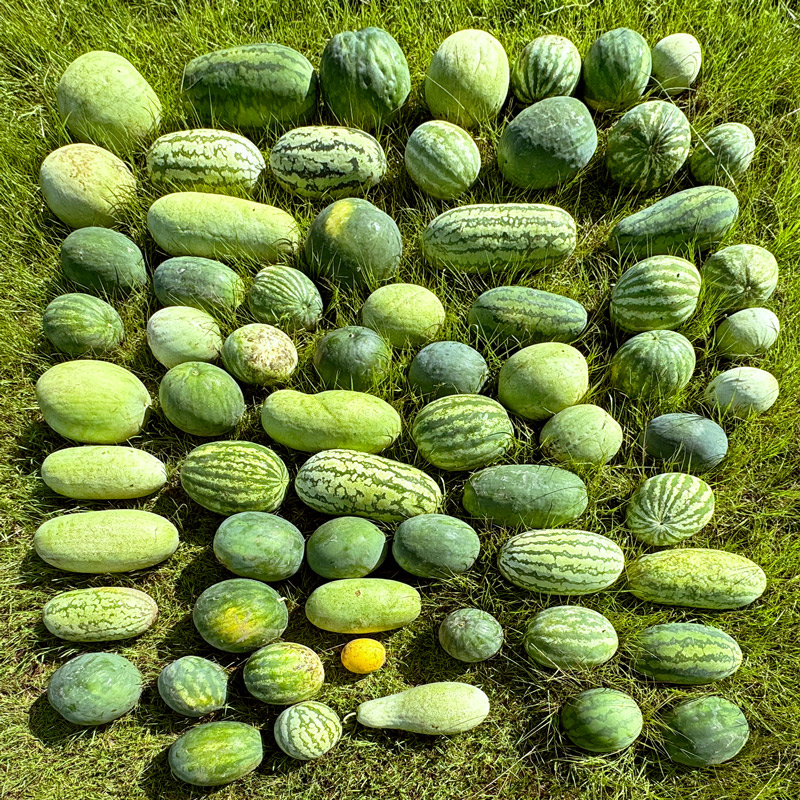
The landrace watermelons my son grows produce in unamended sand with just rainfall. By allowing nature to kill the weak, the strong survive and breed, giving you stronger stock that can weather local conditions much better than a variety created for maximum yields requiring lots of inputs.
In this age of rising fertilizer prices and erratic weather, it makes sense to save seeds from varieties that can take abuse. It’s better to have lower yields – and get a yield – than it is to shoot for very high yields and get complete failure due to lack of inputs. The centralization and promulgation of modern seed production is making us more fragile than ever before.
The same goes for animals that are vaccinated, wormed, medicated and fed carefully managed diets. By doing so, yields may increase but the survivability under natural conditions goes way down.
If you’re interested in growing your own bomb-proof vegetable varieties, I highly recommend Joseph Lofthouse’s book.

2 comments
Thanks for sharing!
Corporations are things, organizations formed for the sole purpose of maximizing profits for their constituent members, while insulating them personally from any possible undesired effects or consequences resulting from the opposition of individuals or factions within society-at-large.
As things, they have no morals, ethics, or hearts; the ruthless treatment of subsistence farmers around the world by giga-groups such as the aforementioned agri-conglomerates is simply business-as-usual for those corporations that categorize people as things.
Neil Armstrong’s words to the world in 1969 bear considering, adapted to the landmark ruling by Kenya’s High Court: “That’s one small step for a nation, one giant leap for mankind.”
Comments are closed.