
Growing blackberries in Florida isn’t too hard… but growing most raspberries is another story. Today I’m going to share how you can grow both; however, you’re not going to be able to grow both in all parts of the state, so I’ll cover the climate aspect as well.
I received an email recently on the topic of growing raspberries and blackberries in Florida and that triggered today’s post. Let’s just start with the question.
Phil writes:
“I live in Pasco County just north of Tampa and are in Zone 9 right at the boundary of A and B, our soil is mostly sandy with low levels of organics. I live on the site of an old orange grove.
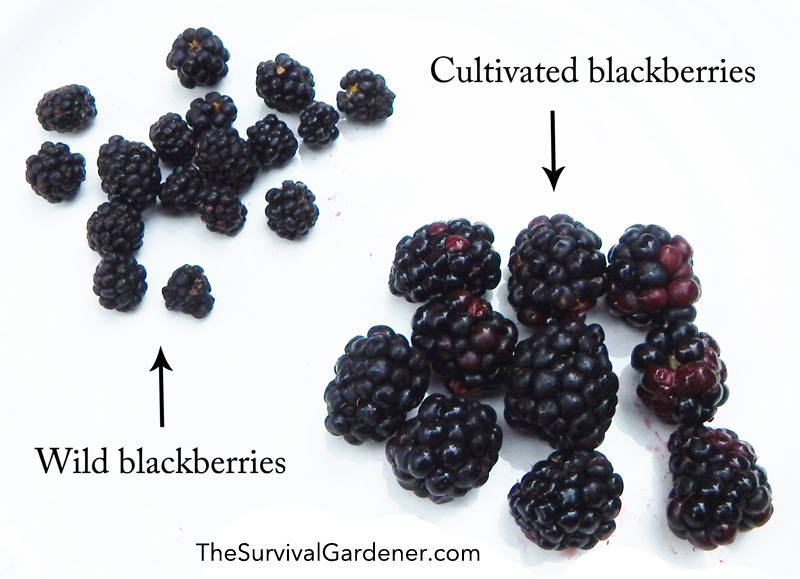
I would like to try my hand at some Raspberries and maybe some Blackberries. I have seen wild blackberries in the areas of our community that have been allowed to revert to natural, but they are small and somewhat bitter.
Growing Raspberries in Florida
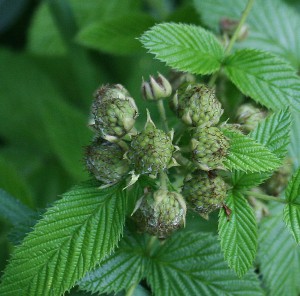
Ripening Mysore raspberries
The nasty thing about Mysore raspberries is their incredible spines. These cane fruit are vicious and even bear spines on the leaves themselves.
I’ve enjoyed growing Mysore raspberries ever since my friend Andi blessed me with a little baby one in a pot a few years ago. That has now grown into a monster plant and borne multiple times. It’s also rooted into the ground outside of its bed here and there. Wherever the canes get a little buried, they’ll start a new plant. I’ve been able to share quite a few thanks to this habit.
Besides Mysore, there’s another raspberry called “Dorman Red” that’s sometimes recommended for Florida but it’s very marginal. I only got one fruit from mine in three years, then it died. Raspberries in general don’t like the heat here and I also believe the winters aren’t cold enough to stimulate them into decent production.
The final variety of raspberry you’ll sometimes see in Florida is the Southern selection “Caroline”. This one produced more fruit for me than Dorman Red, but I only had them growing in pots in my (now defunct) plant nursery. It needs more testing to see if it’ll be worth growing here long-term.
I believe both Dorman Red and Caroline appreciate some shade. Both are very cold-hardy. Mysore doesn’t seem to mind the heat, though it may freeze down during a cold snap that reaches into the low 20s.
Growing Blackberries in Florida

Blackberries picked at Taylor Gardens Nursery
I grew Apache up in Tennessee and down here in Florida I’ve grown Natchez, Ouachita, Kiowa and Arapaho. You can see the University of Arkansas blackberry list and recommendations in this free .pdf.
pH and Cane Fruit

Growing Cane Fruit in South Florida
One Final Option for Florida
I mostly relegated blackberries and raspberries to the novelty side of my gardening plans after discovering the incredible productivity of mulberries.
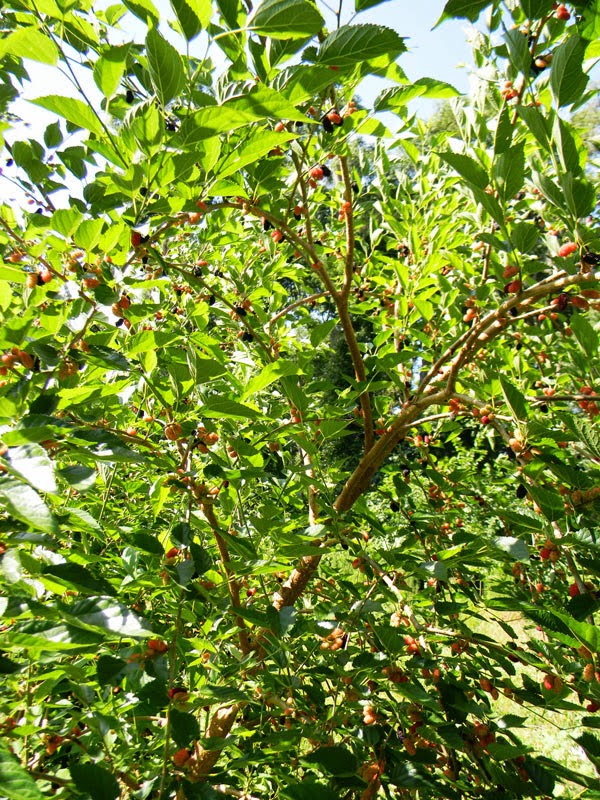
Mulberries taste like a seedless and perfectly sweet blackberry
One mulberry tree will produce gallons of fruit with less work, less care and less water than any cane fruit. They also produce for years, don’t need weeding or mulching, plus will bear in just a year or two after planting.
I suppo se if you wanted to get really clever, you could grow a mulberry tree, then plant cane fruit around it to bear a multitude of berries from the ground to the sky.
Good luck with your berry growing plans – may you end up with plenty of delicious fruit.


35 comments
I’ve all but given up on blackberries here in north Florida. You’re right about needing supplemental water in the spring and I haven’t taken the time to do that with mine. The 2 I have left are a Ouachita and Natchez. They certainly haven’t thrived, could be the ph, but I have blueberries nearby and they’re doing fine. There are too many other things I know will grow well here, so I probably won’t invest any more time on them.
Give those berries some mulch and some good nutrition. Chances are the soil is poor, since the blueberries are doing well.
I’m down in zone 10B. Saw some blackberry cuttings at the Depot so I picked up a couple of varieties. This was about 18 months ago. They are in large pots placed in direct sun to partial, to shady. None seem to be thriving.
Last summer a friend gave me a four foot tall mulberry cutting that she had started for me off her tree. Unknown variety. It is now 10-12 feet tall and has produced a few berries by accident, I think. Like I said, it is less than a year old. Is there any specific compost/coffee grounds mix they really like? I have access to a lot of coffee from our church kitchen and was wondering if it can just go directly on to the ground under the tree. I am looking to pick up a few more mulberry based on your recommendations and observations. Do you recommend a web page for mulberry cuttings?
Burnt Ridge Nursery has some excellent ones. Don’t buy from Gurney’s or TyTy.
http://www.burntridgenursery.com/Mulberry/products/20/
Yep, throw the coffee around the tree. The best thing for increasing growth is to water thoroughly, then lay cardboard over the grass around the tree, up to about 4′ from the trunk, then mulch on top of that and water it again. Killing the grass and mulching is great for fruit trees. You can also throw on some good compost. Fish emulsion is also great. Lacking all those, a cup or two of 10-10-10 scattered around the base of the tree will get it going. Generally, though, mulberries need very little to stay happy.
I Live in Miami, would love to grow Raspberries since blackberries nor blueberries will grow down here. Please let me know where I can find them?
Hi you said you are in Zone 10B? I am in Miami, would love to grow Mulberry tree Please let me know more. My email is slinky58@gmail.com thank you so much.
I’ve been keeping my blackberries and raspberries in giant pots, but I plant on letting them loose in the back corner of the farm to make an edible barrier and to see if they can out-compete some of the other vines.
RELEASE THE CANES!!!
When I was in Miami years ago I thought it was the cane capital of the US.
Great article on Florida Blackberries and Florida Raspberries. Thank you for posting it. By Dr. Gregg L. Friedman MD
Thank you – you’re welcome.
Where can I find MYSORE RASPBERRY Rubus niveus???
Not sure – try local gardening meetup groups.
Lowes usually carries Mysore in the spring at least they do in Ocala and Gainesville
Hello, I camp a- lot in the forest. And I have found Red Raspberries on a small bush. The size of a rabbit was the bush . And they were was bright red berries. The plant is in the in the center were there was not much light. There was just a little. Sadly the forest it being overtaken by vines and termites. It seems fragile. The grounds is piled with sticks. Life goes on and plants grow and trees get tall discarding branches.
They were probably immature blackberries if you found them in Florida.
I live in Daytona Beach Florida. I moved from Ohio where Blackberries grew on my pasture fence. I want to try just one plant to see how it does down her. I’m confused about what type of soil and should I start it in a pot. Any helpful ideas would be greatly appreciated.
Add compost and grow in the ground if you can.
I live in Stuart Fl. A friend give me 3 tiny blackberry plants I planted them under a small oak tree for semi shade. Neither of us know what type they are, but they are now taking up a 12 x 15 foot area and provide berries the size of your thumb. Wish I knew the type of berry to let you all know. They have mean thorns, I keep them trim to 3 foot in length. I mulch with pine bark and give them acid fertilizer. They fruit in April. If anyone is determined to grow them keep trying the thorny ones. Soil is at a 7.5 to 8 ph level here so I mulch with pine bark on all my beds. It’s been 3 years and everything I plant grows like crazy now that the pine bark has broken down.
Thank you for posting so many great videos and blogs. I’ve learned so much.
Dewberries (Rubus trivialis) are supposed to do fine in central (& north) FL, but take some management because they want to be low groundcovers (you can manually trellis them), are self-incompatible (you need 2 different clones), and thorny. Improved cultivars “Flordagrand” and “Oklawaha” may still be sold somewhere.
I live in eastern Pasco co , 4 mile from the green swamp
We have over 700 plants with drip irrigation , we planted in March 2017 from sprouts. Natchez variety, the have taken over , canes are as big as my thumb at the base , runners are 15’+ long with laterals all over, on 4 wire trellis. I need to trim back to 3′ to 4′ , but when. Need help.
Thank you
Randy Barrett
I would like to try some blackberries.. however everything I read is that they are high maint…. and run a lot…. is there any in a bush that can be trimmed to keep manageable… I am in north florida zone 8..
I grew the thornless Apache type and they did well for me. Yeah, they ran, but they weren’t that much trouble. If you really want low work, plant mulberries.
Good article! I live in pasco county in Florida and recently found a mess of blackberry bushes nearby and have had some success in transplanting them. I’ll give ’em some coffee grounds to make the soil a little more acidic, and compare. Good fruit from some of the wild ones and i hope to get the soil jyst right to maximize fruit quality. Thanks again!
Very cool, Brian. Good work.
The wild blackberries in Florida are actually called dewberries.
Mulberries in Central Florida: I have a mulberry bush that I grew from a cutting only last year, planted outside my chicken coop for shade. Compare with another in the corner of the years, the one by the chicken coop produced buckets of berries. Nice and sweet. I didn’t really water it too much in the spring but it likes the natural a fertilizer. I let the chickens out now and again to scrounge for berries. Great option in 9B
Very good! The one I grew in a chicken run also grew amazingly fast.
What other berries (perennials) grow well in North Florida? I’m so tired of trying to grow a garden every year using annuals and failing miserably. I’ve had blueberry bushes for years, do nothing with them and they grow like crazy – that’s the kind of garden I want, any suggestions?
The very best is mulberries. You might have acid soil. Are you in a pine/palmetto area? If so, then growing annuals is tougher. Look up some of my posts on pines, palmettos and scrubland for some ideas.
I have a GIANT mulberry tree that’s taking up my whole front yard, I love it. And yes, lots of pines and oaks around my property. I’ll look up your suggestions, thanks for responding!
I live in the Panhandle of Florida…blueberries do well and blackberries have an abundance of berries each year…not too large but very sweet and tasty. They have grown in our fence rows as far back as I can remember My Mom always made jelly each year and lots of cobblers. Mulberry trees are also easy to grow and fruit well.
I lived in Davie from 1979 through 2015. In the 80’s I picked lots of Mysore Raspberries every year. With global warming my raspberry crop was significantly less. I also grew Brazos Blackberries but always had small crops. My son in Jax took Brazos cuttings and has had huge crops. He has also had very good crops of Mysore with my cuttings. I agree with you that the best berry for Florida is the Mulberry. It tastes great and produces well. My grandkids (and their grandpa) love them.
Does anyone know if Boysenberries can be grown in South Florida? I have seen them growing well in Oregon and New Zealand but never in Florida. By Gregg L. Friedman MD
Has anyone tried raspberry shortcake- it’s thornless, height 2-3 ft? It grows in zone 9. I’m trying my hand at it. So we shall see.
Comments are closed.