
Feeding chickens without buying feed has been a long-time goal… but it’s a goal I’ve never successfully pulled off.
A few years ago I wrote a post on the topic of home-grown chicken feeds for The Prepper Project.
There are many problems you’ll encounter when you dig into the nitty gritty of feeding your backyard flock. Let’s jump into them one at a time.
Chicken Feed Is A Weird Collection of Junk
The typical bag of chicken feed you get from your local farm supply is a combination of GMO corn and soy with other fillers, often including pig guts and even poultry wastes.
That means you’re feeding chicken to your chickens.
Other ingredients include bone meal, restaurant grease, canola (which is also a GMO) and barley malt left over from brewing.
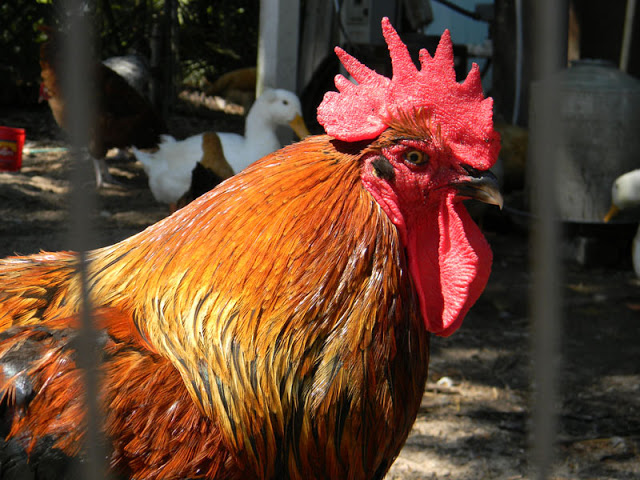
Don’t feed me no weird stuff, yo!
Modern chicken feed is a bizarre collection of bits and pieces. If you’re not comfortable with having genetically modified organisms and chicken wastes being brought onto your homestead to feed to your chickens, I don’t blame you.
However, if you want to buy “organic” chicken feed that doesn’t contain all the weird stuff, it’s going to cost you. $40 a bag isn’t uncommon. That’s compared to the $13 – $16 I paid per bag for the cheap commercial feed.
The chickens don’t seem to know the difference between feeds, either. They’ll lay eggs when fed the nasty stuff and they’ll lay eggs when fed the good stuff.
I’d rather give them all great food but my budget didn’t allow that… so we gave them the cheap feed and supplemented their diets with good nutrition from other sources, such as extra produce from the garden and fresh pasture where they could munch on weeds, grass and insects.
Feeding Chickens with Homegrown Chicken Feed
You’ll see recipes for mixing up your own chicken feeds from time to time. I’ve found that the effort, money and time involved makes this unattractive. Unlike some chicken enthusiasts, I don’t want to spend all day babying my birds. I’ve got gardens to dig and books to write!
Justin Rhodes covers some innovative methods for stretching your feed budget and getting the most from your feeds in his Permaculture Chickens movie (you can see his free videos here) but I haven’t gotten to experiment with those ideas yet as we’re in-between homesteads right now.
You could technically grow enough food for your chickens if you planted them some gardens with high-protein legumes mixed with grains and roots for carbohydrates. Chickens will also eat just about any kitchen scraps you pitch their way, including meat, vegetables, pasta, Vienna sausages, ramen and birthday cake. Chickens are the pigs of the bird world.
The problem in feeding chickens is protein. We’ve fed them on homegrown grains, vegetables and kitchen scraps, only to have them quit laying. They need the protein levels found in chicken feed. If they don’t get enough protein, they may be happy and scrappy, but they won’t lay any eggs.
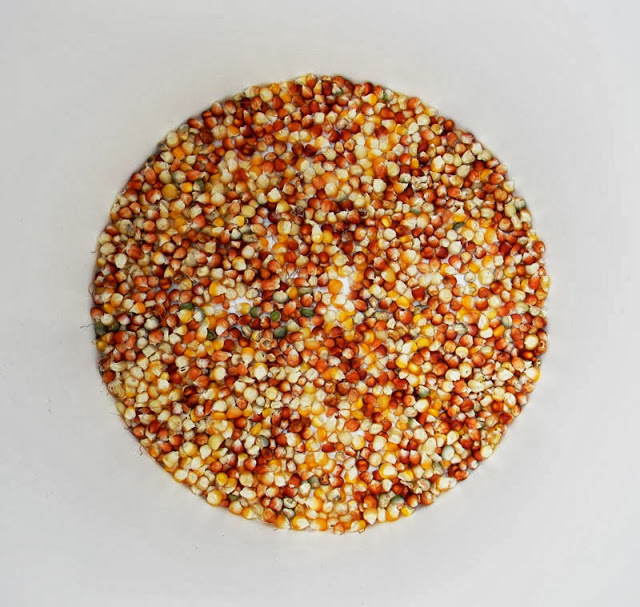
Heirloom corn we grew in part for homegrown chicken feed
Getting the right ratios is tricky. Modern chicken feeds, despite their unsavory ingredients, are well-balanced in their carb/protein ratios.
If you’re feeding your birds lots of good stuff but they aren’t laying eggs, they’re not paying their way on the homestead.
If I just quit here and said it was “tough” to get enough protein for your chickens, I’m sure people would write comments talking about soldier flies, mealworms, maggots and earthworms… so I’m going to cover those as well.
Soldier Flies, Mealworms, Maggots and Earthworms
All of these are potential sources of protein for your chickens – but have you ever tried to produce any of them on any kind of scale?
Soldier flies produce those chunky, half-flat, segmented maggots in the compost pile. Chickens love to eat them and they’re high in protein – but getting enough of them going, particularly year-round, to feed more than a couple of hens would be tough. You’d need a good source of compostable material and you’d need a good way to harvest them. I’m not saying it couldn’t be done on a large enough scale to give your chickens enough protein – in fact, I’m sure it can – but it would take some engineering skill to pull off.
Mealworms are similar. They’re the larvae of the darkling beetle and can be raised at home with some simple techniques, but there is time and labor involved, plus you’ll likely have to buy grain materials to feed them. Do you want to become a full-time mealworm farmer in order to feed your birds? I don’t.
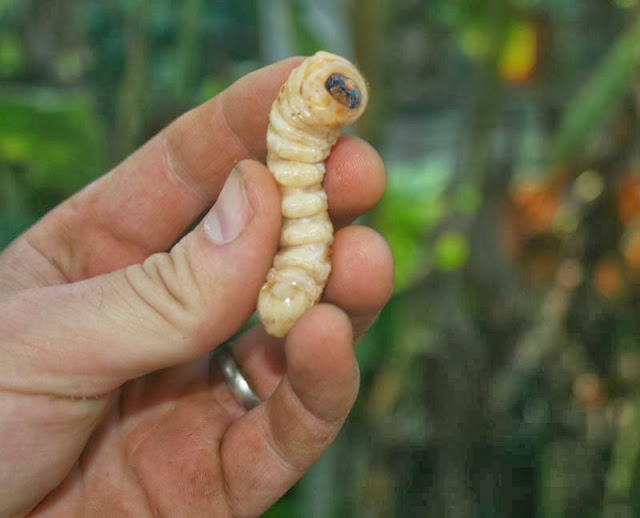
Chickens will eat some really creepy things – like this wood-boring beetle grub.
Another chicken protein source idea that’s always kicking around online is the “roadkill in a perforated bucket dropping maggots in the chicken yard” approach. This is a disgusting and stinky way to feed your birds. Carrion flies carry diseases and potential illnesses that can kill your birds, plus your chicken yard will smell like death if you do this. I’m obviously in favor of returning organic matter to the soil, but I’d rather buy roadkill and plant a fruit tree over it, not have to smell it for weeks in my backyard while watching maggots spill into the chicken run.
No.
Earthworms are another good source of protein for chickens but they’re not that easy to grow in quantities sufficient for regular feeding. I’ve red wigglers on purpose and encouraged earthworms on accident through deep layers of mulch, but there are never enough to feed my greedy chickens. If you went large-scale, I’m sure you could pull it off – but then you’ll be a worm farmer. Better to sell those valuable worms to fishermen and vermicomposters, then buy eggs from someone else!
So What’s the Final Deal on Feed?
Since we didn’t have access to affordable organic chicken feed, I calculated that we would be paying way too much per dozen eggs if we dropped the creepy commercial feed.
So commercial feed it was.
But alongside that GMO-cannibal-restaurant-grease-cow-guts junk, we gave our birds other good things to eat. They got lots of fresh grass and weeds as we moved their tractors around the yard. They got to eat insects and caterpillars. They were given kale and moringa and sweet potatoes. They got weevil-filled rice from the pantry. They even got lots of food scraps from church dinners, including beef, noodles, stew and bread.
My chicken feeding has never hit a perfect level, but it did keep the birds laying. When I tried for an affordable organic approach with lots of homegrown materials, they quit laying. So compromise it was.
I’m not done, however. I still think you can feed your chickens off your land and have them keep laying. It’s just a matter of finding the right foodstuffs and the right chicken breed for maximum conversion of food into eggs.
One day it will happen.

17 comments
Thanks for the article. I am at the same place. I now have 7 chickens. I feed them the 12 dollar bag of food from the feedstore. I try to make it go as far as I can. I supplement with weeds… biden alba.. Spanish needle and other stuff from the yard. I have discovered that they love water hyancith. I have a large amount of the stuff and I am doing civic duty by getting rid of the stuff. Pin a medal on me. How it got in my pond … well I couldn’t say…. but it keeps multiplying especially in the summer.
Protein is another matter. I use to let my birds free range for about 3 years and then I found a bunch of red feathers and no rhode island red. Now I keep them in the coop until I can find time to make an area for them that is predator proof.
Side note… after having chickens for about 5 years… a younger one is in the brooding mood… my first experience with this… do I need to completely separate her? She seems to have stopped eating… any advice?
Keith
I absolutely love your pragmatic, matter-of-fact, Marxian-the-end-justifies-the-means utilitarianism. I have a feeling we would be best buds in real world. I always catch flak from my wife and others from being that way.
Keep up the good work. I’ll be sending you some pics from my garden next week so you can help me diagnose some problems. (hopefully)
There are some other people around here who have experimented with supplementing chicken feed by growing various semi-wild grains, especially millet. Millet doesn’t require any irrigation or fertilizer and is high in protein.
That’s why I free ranged mine. Not because I am concerned about what is in commercial feeds, but because I’m cheap. And also, I wanted to know how they’d do if you couldn’t get it. I have been able to let them roam all summer without any feed from me. Of course, I live on 15 acres, so that may not work for everyone. The biggest downside is that you lose a few to predators and I had one get run over on the road.
They love food waste, and yes, even chicken and eggs. A good use for eggs that are not fresh is to scramble them for the chickens. Mine get to pick the bones on game that I harvest, and sometimes they get the whole thing on varmints.
My biggest source of free feed is that I live in the corn belt. Farmers spill grain while harvesting. If they don’t clean it up, I do. I have empty feed sacks and barrels full of corn and wheat.
I set up a worm compost bin using a truck tool box that I didn’t use, so I saved many bags of leaves to use as worm food and organic material inside the worm bin. I poked little holes into the bottom of the leave bags so that worms could get at the leaves while they are sitting in the grass waiting to be put into the worm bin box. Each night, I’ll go out there and the chickens know to run up to me and the leave bags. I quickly move each bag, and when I do, worms scurry and try to go back down their holes, but the chickens are quick to grab and eat them. This method has added a constant stream of protein for my chickens to supplement their free ranging and home-grown chicken feed. And as for the worm bin, I didn’t have the money to guy 5 pounds of worms like I’ve seen people do online, so when I move the bags of leaves, I grab some myself and put them into the worm bin box to populate it. Until I reach a high enough level of worms inside the bin to start producing lots of worm tea to drop down into my bucket, I “milk the bin” by pouring water into it every three weeks or so, which washes through the bin and collects in the bucket below. My garden plants have already responded well to the added worm compost tea. Win, win, win for everyone.
This sounds like a great idea!
Try growing Azolla or duckweed in a bath tub. A pond is even better. It grows prolifically and is filled with protein. At least in the warmer months. I hope I can supply a link, from a former permaculture farm, in Australia:
https://www.milkwood.net/2012/08/06/azolla-water-fern-as-protein-rich-animal-feed/
This is a comprehensive article, about the pros and cons of growing Azolla as a source of prolific protein on the farm. It can be fed to animals and also fed to the soil.
I was not sure if I should comment on this article for you or not
http://www.offthegridnews.com/survival-gardening-2/18-things-you-should-never-ever-compost/
Hehhehheh
We let them feed at will from wild bird seed ( a mixture of millet, sunflower seeds and corn), black oil sunflower seeds and a handful of mealworms, all if which we bought from tractor supply, together with what they got from free ranging an I/8 of an acre, the usual kitchen waste and we also gave them a plate of moistened oatmeal (oats bought in bulk at supermarket) most days . They never ate the commercial chicken feed when given the choice. We also fed their own egg shells back to them and on occasions a tin of sardines when they seemed to be begging more than usual.
Sounds like a great solution.
Corn and soybeans are cheap, if you buy in bulk. Check out the local farm supply services. You can probably buy soybean meal in bulk. Yes, it’ll be GMO, but plenty of protein. ANy place that sells people food will be way more expensive.
That’s excellent. I know I’ve been able to buy cottonseed meal to feed my cabbages.
My neighbor & I have our local feedmill make us a 1200lbs batch of feed & we pick it up in an old combine bin. You can get it in you pickup bed and off load it into containers such as trash cans, anything that seals tight enough to keep rodents out.
Our feed usually costs less than 11 cents per pound. We don’t care about GMO’s, but we don’t get any meat & bone meal. Here’s the product list.
Corn
Soybean meal
Milo
Dried Distillers Grain (ddg)
Calcium
Land O’Lakes poultry fortifier
Lysine
Chlorine chloride
There maybe some other micro ingredients that I can’t think of now, but you get the point.
Less than 11 cents – whoa.
A local feedmill is a great resource. Thanks for the ingredients list.
We raise chickens and rabbits for meat and eggs, ducks, worms, and bees. I’m one of the ones who continues to shell out for the organic feed each week. This is a great disagreement between my husband and I. For me, one of the reasons I raise most of my own meat, eggs and veggies, is so I can minimize my part in the great human and evolutionary experiment of gmos. And in my mind if that’s what I’m feeding them…But from personal observation over the past 15 years, I would disagree that the chickens do not know a difference between the conventional and organic feeds. On many occasions I have had to resort to conventional feed because a local supply of the organic was not available. There is a noticeable difference both in the feed itself and the way the chickens react to the different feeds. I’ve also tried several experiments where I have mixed conventional and organic together. In both my chickens and my rabbits, they will eat through the organic first leaving the easily identifiable conventional feed at the bottom of the barrel. Yes if they are hungry enough, they will eventually eat the conventional feed and in the case of the chickens they will continue to lay eggs. But even my die hard conventional feed (cheapest possible means, road kill if I permitted) pushing husband admitted that the chicken eggs and meat are better when they are on an organic diet. I guess it’s a personal choice. I live cheap in nearly every aspect of my life. But when it comes to food, that’s what I live and work for. One must always calculate the true costs of cheap and where he or she is willing to make the sacrifice.
Btw. I’m just being introduced to your site. And I love it. I am planning to send some photos to your Seminole Pumpkin project soon.
Thank you. I would love to feed them the good stuff as well. Interesting observation about them picking out the organic. It seems some animals are smarter than we are!
Comments are closed.