Harvesting rain water should be a priority for any serious prepper or gardener.
Did you ever go on a long hike, then find yourself parched with thirst? The need for water catches up with you quickly.
If the city water or your well shut down for a week, would you be able to survive or would your house become unlivable? Stockpiling guns, gold and food is a good idea – but having a way to hold on to water is of paramount importance.
Fortunately – in most climates – God gives us a ready supply from above if we can just figure out how to capture it. I’ve been harvesting rainwater on a budget for years and have figured out what works and what doesn’t.
Today I’ll share my top 7 mistakes to avoid when harvesting rain water. I’ve also put them into a video version:
Let’s jump into the mistakes, starting with a very common one.
Mistake #1: Make It Expensive
Harvesting rain water DOESN’T need to be expensive!
If you have a larger budget and plan on keeping your homestead for a while, there are excellent systems with diverters, filtration, underground cisterns and pumps – which are great – but not necessary if you’re having a hard time rubbing two nickels together. You can do this on the cheap. I’ve even converted trash cans to rain barrels:
 Though after I set up a couple of homemade rain barrels at my old homestead, I realized I could capture a lot more water for free by creating ponds.
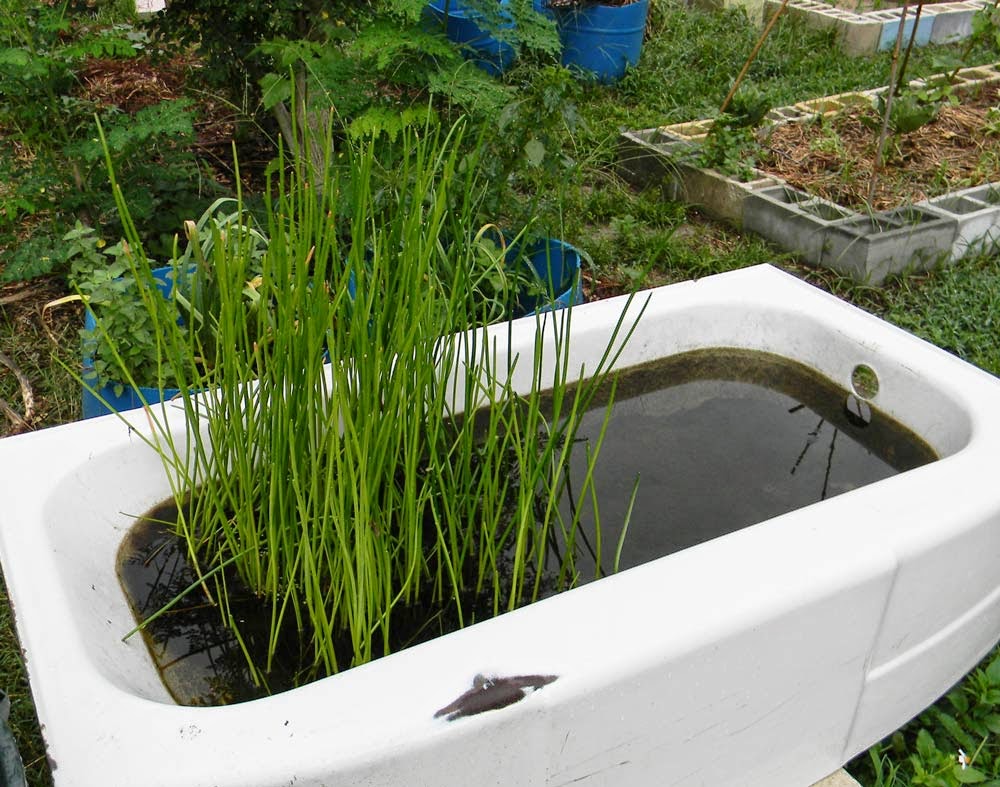
Instead of digging proper ponds with expensive liners, I got a pair of solid old hot tubs from a local pool company. All I had to pay was a delivery fee (these suckers were too heavy for me to move!), then find PVC caps to fit the pipe holes in them. Direct a gutter into a hot tub and you’ll hold hundreds of gallons of water. I planted mine with edible and useful aquatic plants and threw in some local “mosquito fish” and goldfish to eat any mosquito larvae that might show up. I also scored another hot tub by the side of the road, taking my total up to three.
The total capacity was roughly 1200 gallons between them and I had plenty of water to keep my gardens alive through any drought.
Mistake #2: Let the Mosquitoes In
Mosquitoes can take a great idea and make it a health hazard. As new viruses sweep around the world, people are rightly concerned about the danger of harvesting rainwater improperly. Even old tires hold enough water to breed mosquitoes, so a rain barrel has the capability of breeding thousands of the bloodsuckers.
The best way to keep them out is to keep your rain barrels or cisterns covered so mosquitoes don’t lay their eggs. I’ve covered mine with screening in the past, then had the screening get pushed in during a heavy downpour, which then let mosquitoes lay eggs, leading to a bunch of squiggling larvae.

I cover compost tea barrels and rain barrels with
screening but it isn’t foolproof.
A friend with an excellent rainwater harvesting system much bigger than my own told me that he had issues with mosquitoes occasionally due to openings, but he had used “mosquito dunks,” which are a non-toxic mosquito-killing product comprised of bacteria that sicken and kill the larvae. Just desserts!
I tried it and they worked like a charm; however, the best method is just to keep things closed.
Mistake #3: Choke The Flow
This was my first rookie mistake.
I built a pair of rainbarrels and carefully attached spigots to the bottoms of them, hoisted them a few feet above the ground on stacked cinderblocks, then directed in the gutters. After the first rain I was excited to give them a test, so I put a bucket under the spigot and opened it fully. To my great irritation, the faucet aperture was too small. It would take about three to five minutes to fill a bucket. That’s an eternity if you’re hoping to get some watering done, and it meant I used those rain barrels a lot less than I would have if they had generous faucets.
A friend has a great big PVC outlet on the side of one of his 1,000 gallon cisterns that allows out a blast of water when cranked open.
That’s what you want – don’t use fiddly weenie faucets!
Mistake #4: Go Too Small
Don’t go too small…

2 comments
[…] His focus on gardening, culturing trees, and managing water for economic production of foodstuffs is rare among survival bloggers, and he writes engagingly. To wit, in a post about managing water storage: […]
[…] His focus on gardening, culturing trees, and managing water for economic production of foodstuffs is rare among survival bloggers, and he writes engagingly. To wit, in a post about managing water storage: […]
Comments are closed.