I’ve been reading The Independent Farmstead by Shawn and Beth Dougherty. It’s a good read (I am about 2/3 of the way through), with practical and useful information on making your homestead/farm less dependent on the outside world, and particularly the toxic sphere of Big Ag.
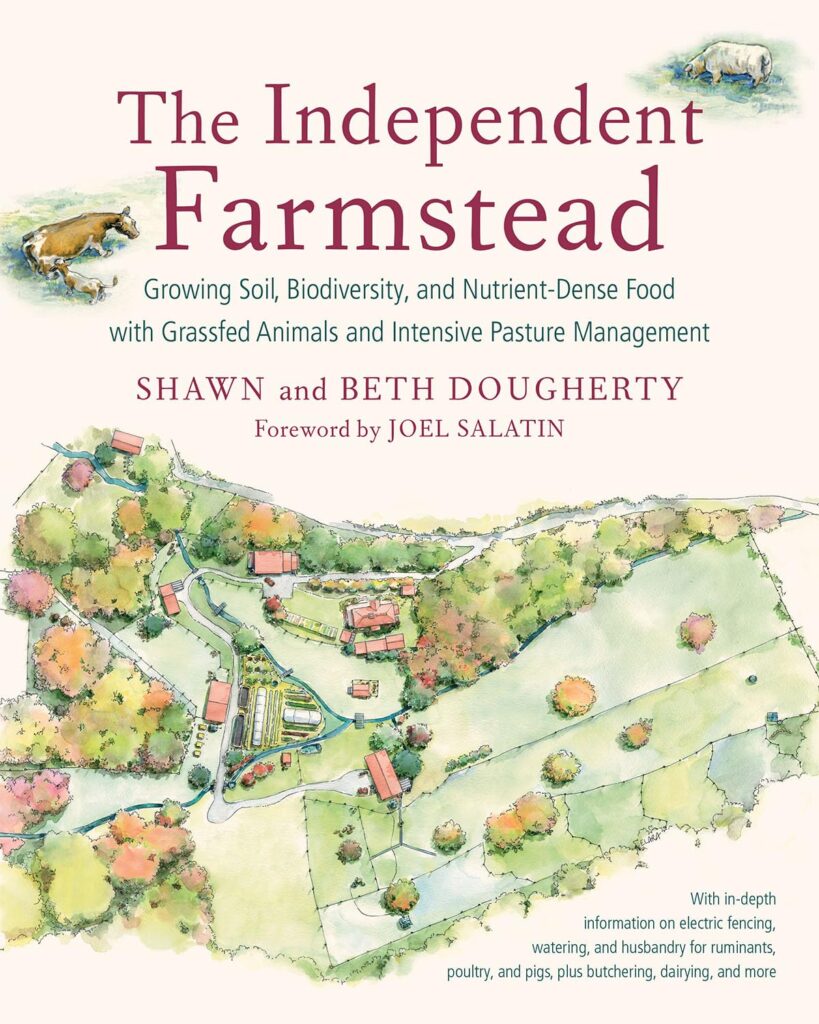
Their focus is heavily on animal food production, including eggs, meat and dairy, in a temperate climate.
Now that we own more land, we are also shifting our focus to animal food production, and the pasture-building techniques and simple systems in this book are quite worthwhile. The gist of the book is that they took a piece of very marginal (and affordable) land and turned it into a productive homestead, and you can too.
Publisher’s description:
With in-depth information on electric fencing, watering, and husbandry for ruminants, poultry, and pigs, plus butchering, dairying, and more
“If we work hard, we sleep well.”
Twenty years ago, when authors Shawn and Beth Dougherty purchased the land they would come to name the Sow’s Ear, the state of Ohio designated it “not suitable for agriculture.” Today, their family raises and grows 90% of their own food.
Such self-sufficiency is largely the result of basing their farming practices around intensive pasture management. Pioneered by such luminaries as Allan Savory, Greg Judy, and Joel Salatin, the tenets of holistic grazing―employed mostly by larger-scale commercial operations―have been adapted by the Doughertys to fit their family’s needs. In The Independent Farmstead, The Sow’s Ear model for regenerating the land and growing food―“the best you ever tasted”―is elucidated for others to use and build upon.
In witty and welcoming style, The Independent Farmstead covers everything from choosing a species of ruminant and incorporating it into a grass-based system to innovative electric fencing and watering systems, to what to do with all of the milk, meat, and, yes, manure that the self-sustaining farm produces. Within these pages, the Doughertys discuss how to:
- Find and improve poor, waste, or abused land and develop its natural water resources;
- Select and purchase the appropriate ruminant for regenerating your farmstead;
- Apply fencing strategies and pasture management basics;
- Implement basic, uncomplicated food processing, including large and small animal butchering and cheese making; and
- Integrate grass, gardens, and livestock to minimize or eliminate the need for off-farm inputs.
As the Doughertys write, more and more people today are feeling “the desire for clean, affordable food, unmodified, unprocessed, and unmedicated and the security of local food sourcing for ourselves and our children.” The Independent Farmstead is a must-have resource for those who count themselves as part of this movement: both new and prospective farmers and homesteaders, and those who are interested in switching to grass-based systems. Best of all it’s the kind of rare how-to book that the authors themselves view not as a compendium of one-size-fits-all instructions but as “the beginning of a conversation,” one that is utterly informative, sincere, and inspiring.

1 comment
Wonderful book! I read it too. I’m especially keen to read anything by farmers in Ohio since I live in the same state. If they can do it, some day I will be able to as well. Gene Logsdon is another favorite if you haven’t read his books yet.
Comments are closed.