I was doing some work for a client this last week. I was training a gardener to build a compost pile so we went biomass gathering around the farm, bringing back piles of rotten fruit, cut grass and green weeds, along with dried grass and leaves so we could make alternating layers of greens and browns.
While gathering rotten piles of brown grass from a recently cleared field, I discovered something annoying.
Inside the rotting grass were pieces of wedelia stems, rooting and green, just waiting to be added to the compost pile where they could infect the gardens forever. I looked around at the area where the grass had been cut and saw lots of the same species growing among the grass.
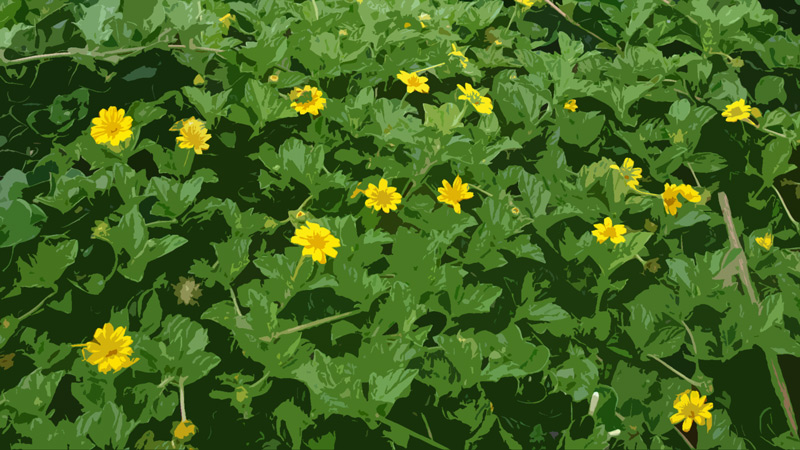
Wedelia, also known as Singapore daisy, or most properly under the tongue-twisting Latin name Sphagneticola trilobata is a pain-in-the-neck plant often used as an ornamental for its thick growth and pretty yellow flowers.
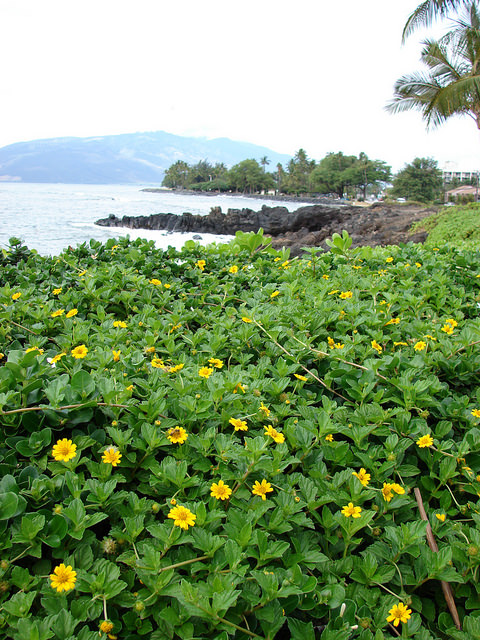
It’s also known for reproducing rampantly from runners and pieces of the cut vine:
“Wedelia is a mat forming perennial herb with rounded stems. Leaves are fleshy, usually 2 to 4 inches long and 1 to 5 inches wide, with irregularly toothed margins. Flowers are solitary, one inch in diameter and yellow-orange in color. New plants arise from nodes that root at the soil surface. Seed production is low and generally does not reproduce prolifically via seed. However, wedelia is able to escape from gardens to nearby areas via runners and fragmentation.”
I know I tell you to “compost everything,” but there are times when we have to exercise some care lest we introduce an invader into our gardens. I don’t trust that the pile I built is big enough or will get hot enough to cook wedelia pieces and keep them from ending up running through and over the compost pile. I can’t uncover research on feedng wedelia to rabbits, chickens or goats, but if it won’t hurt them, that would be a better way to turn it into something usable for the garden. Another option might be my anaerobic barrel composting method.
Compost everything (if you can!)
If you already have wedelia in your yard and landscape, it does make a good groundcover. I wouldn’t introduce it on purpose, but keeping it in beds and string-trimming the edges does look nice.
To get rid of it, you need to pull up all the vines and remove the stems completely, or it will pop back up quickly and take over again.
*Wedelia image by Forest and Kim Starr, Starr Environmental.

10 comments
I hate this stuff it is all over my N Ft Myers, Fl backyard. I looked up if my sulcata tortoise could eat it. Internet said no. High oxalic acid content if i remember correctly. He dont like it anyway. Pot belly pig is disinterested also. There are medicinal uses but i havent tried it. I am planning on composting a lot of it soon with a heavy tarp to block out the sun. Waiting on the first real cold front. Shampoo ginger is my other foe.
[…] post Wedelia: A Pretty Pain in the Neck appeared first on The Survival […]
all deer eat Wedelia?
HA! I have a slope in front of my apartment where nothing grows. The sand just runs downhill when it rains and blows into my house when it doesn’t. I actually have two buckets of wedelia I got from a friend that I’m planting tomorrow. I figure if anything will grow there, that will. If wedelia won’t grow, nothing will. I’ve tried lots of stuff, and basket grass will grow, but it dies in the winter. I’m even trying African Potato Mint because it comes up quickly in the spring and starts growing fast. I figure the wedelia is my best bet, though.
Wedelia should do the trick. If it doesn’t, there’s always Japanese knotweed!
I introduced Wedelia in our mini foodforest with chickens. now with more shade, the digging of chickens, african giant snail infestation and a dry year all grass is gone and doesnt come back/gets eaten when small, so the Wedelia is like the only persistent ground cover. and i observed the chickens are actually eating it.
I’m on the north shore of Maui, and I have a horrible invasion of wedelia over my entire property. Formerly pineapple land with utlisol soil (highly acidic, low in basic minerals), it is hard to get things to grow. But, wedelia doesn’t mind. I recently cleared a section of it as best as I possibly could. I even dug under the ground to remove as many roots as possible. The stuff is already coming back after 3 weeks. Goats should not eat it (my goats had no interest), nor can horses (will causes spontaneous abortions), nor should cattle. I’m trying to find out if pigs can eat it. The only thing online that I’ve read which will kill it are glyphosate (round up) and 2-4d, which are both horribly toxic and I am not willing to use because of how toxic they are to the environment, ocean, and beneficial insects. If you do pull wedelia out of an area, put it into black plastic bags to let the sun cook it, or burn it. Mowing it only spreads it, and unfortunately that’s what happened on this land over the years. It’s choking out the native plant life. I’m sad, and it’s next to impossible to manage let alone eradicate.
Here on Kauai, we use Sedgehammer on it …. intervals of 2 weeks apart as necessary … with a maximum of 3 intervals. Less harmful to the environment than Roundup. Works great. The Wedelia will start to “brown out” after 4 days at each interval.
I didn’t realize that also worked on Wedelia. I’ve never used it, but I know it was recommended for nutsedge control.
I live on Maui. We successfully controlled our wedelia that was growing with grass, by Weedwhacking it, scalping it down to nothing every week for 10 weeks. After 10 weeks, the grass took over.
We also as an experiment covered some areas with cardboard, spread an inch of topsoil with grass seed on top and that worked as well. The grass seed grew, the wedelia died off by being smothered. It can also be smothered with weedmat or tarps.
Comments are closed.