Today we’ll look at how to grow yams, plus this post will serve as a survival plant profile on my favorite root.
It’s no secret that I love yams. How can you NOT love roots that look like this?!
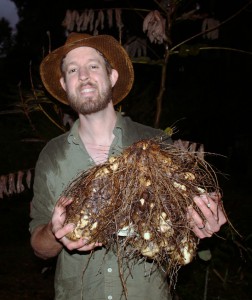
Learn how to grow yams and EAT LIKE A KING!
I’ve been eating yams daily since we harvested 2015’s crop. I still have about 100lbs left on the back porch.
I cover yams in Totally Crazy Easy Florida Gardening with great enthusiasm – and they also get a good mention in Grow or Die: The Good Guide to Survival Gardening.
I find it incredible that they’re almost NEVER covered in Florida gardening books. Come on, folks!
Most people confuse yams with sweet potatoes but they are not the same crop at all. Sweet potatoes are in the Ipomoea family, whereas yams are in the completely different Dioscorea family. No relation!
Now I’m going to cover growing yams and propagation here, so you, the cheapskate internet reader, can benefit from my research without buying my book. (Though if you do buy one of my books, you’ll be my friend forever.)
How To Grow Yams
First of all, you need to figure out what type of yams you’re going to grow. There are the “name” yams you get from the ethnic markets (and often from Publix supermarkets, if you have those in your area), then there are the “water yams,” also known as “winged yams” or, most properly Dioscorea alata, and there are also edible forms of Dioscorea bulbifera (the dreaded “air potato”) that make airborne roots you can eat, and, of course, there’s the cold-hardy Chinese yam of “yamberry” fame, then…
…well, let’s just say there are a LOT of yams.
I’ll try to cover the basics on how to grow yams, then get into some details on individual species. Let’s start first with how to propagate yams.
Yam Propagation
Many yam species have aerial “bulbils” (roots) that you can plant for the next year’s harvest. Some do not.
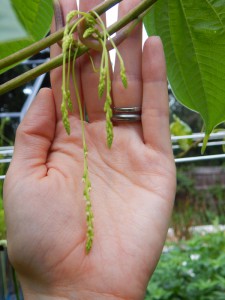
Dioscorea bulbifera blooms
Yams are only rarely grown from seeds except for breeding purposes – and if you live in the US, you’re unlikely to have a long enough warm season or proper light cycles for them to even bloom.
The normal method of propagation is via bulbils for the varieties that produce bulbils, and via divided roots for those that do not.
If you don’t have bulbils, you need to make “minisetts.” All that requires is a good yam root, a knife, and perhaps some ashes to ward off potential soil pests.
Cut your yam root into chunks about the size of a peach, dip them in ashes, then plant them.
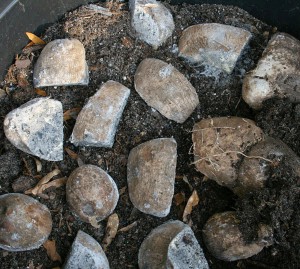
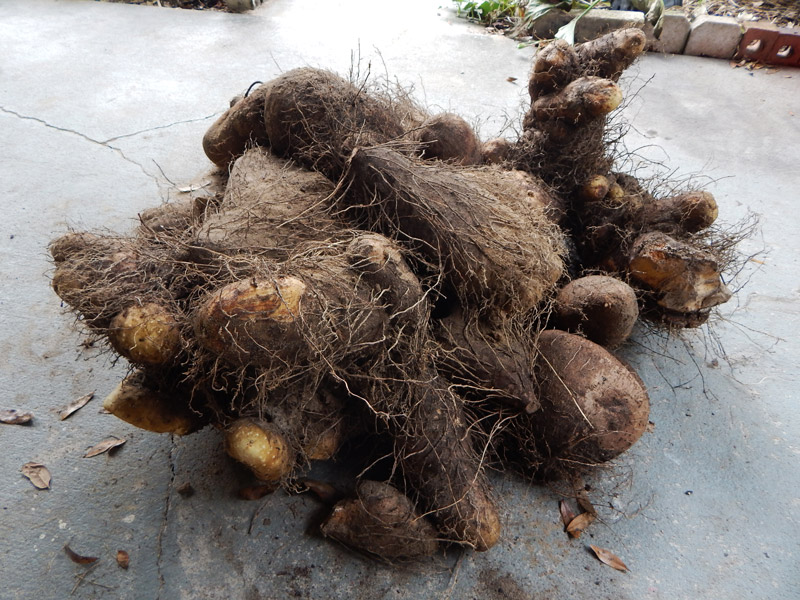
I put a bunch of yams into a big pot full of dirt, then I transplanted the ones that sprouted into my gardens and food forest, resulting in this pile of roots:
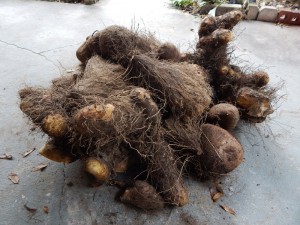
Not all of your yam minisetts will grow; however, most will root and give you some yields.
Another method I haven’t read much about is starting yams from cuttings. I had good luck rooting yam cuttings in a mist house last year. It was surprising how easily yam cuttings rooted. I don’t know if give you as big of a harvest the first year if you start them from cuttings, but I do know they’ll root.
Check out my video on propagating yams here:
Growing Yams
Yams need something to climb – they’re vigorous vines and will happily shoot to the top of a tree if given half a chance.
I plant mine just under the surface of the soil near something – anything! – they can climb when they emerge.
I’ve grown yams on fences, on trellises, on an unused clothesline and even on a pollarded sweetgum tree I used as a living trellis.
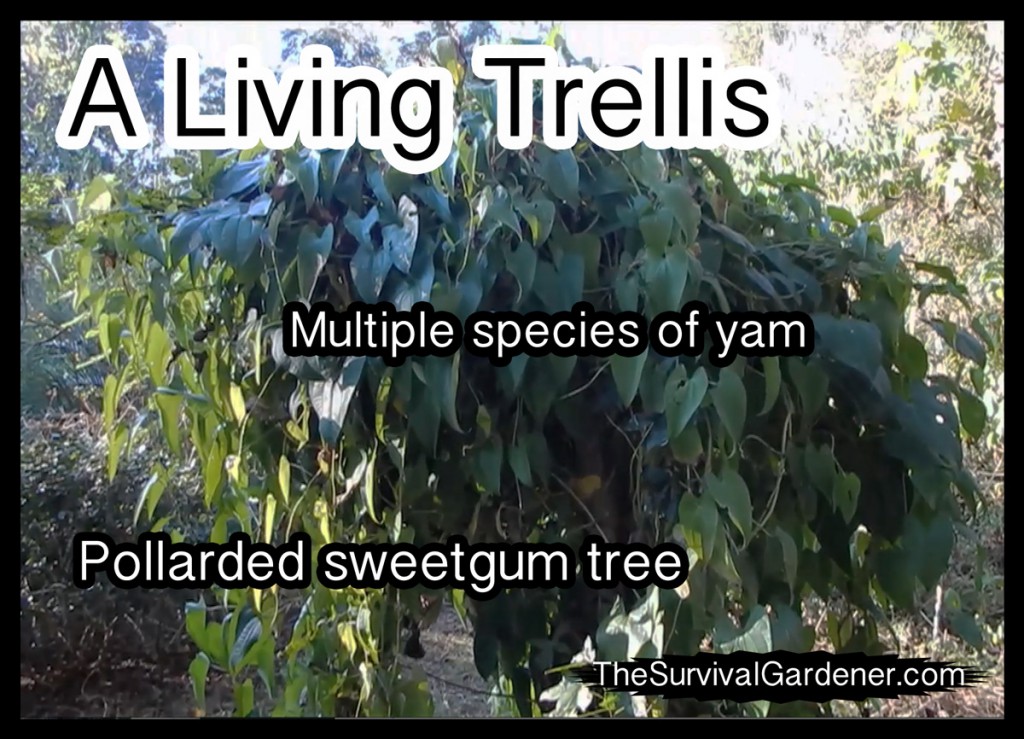
If you have bulbils or minisetts available, plant them in fall, winter or early spring.
Yams have a growing season and a dormant season. Where I live in Florida, they grow vigorously through spring and summer and into the fall, die back and eventually freeze down in the winter.
As the growing season progresses, they start making their bulbils (if they’re a yam that does that) which mature in the fall. The below-ground root really seems to do a lot of its growing into the fall as well, preparing for the winter ahead.
Some species are grown JUST for their bulbils, such as the rare edible forms of Dioscorea bulbifera:
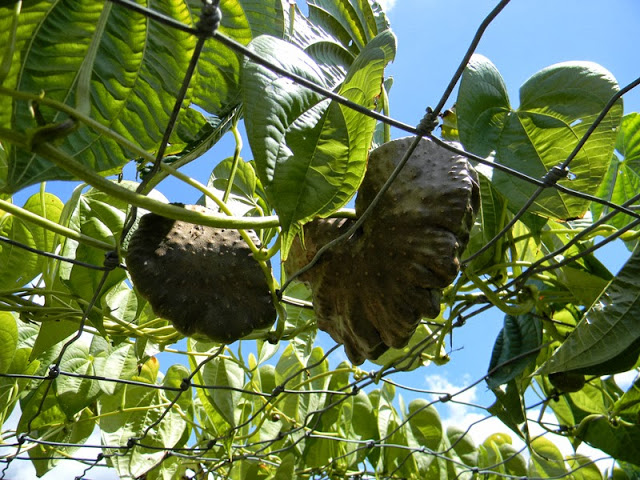
Those can be cooked and consumed like potatoes and the main root stays in the ground, sending up vines and new harvests of aerial roots year after year. More on the amazing edible Dioscorea bulbifera here:
Another yam, the cold-tolerant Chinese yam (Dioscorea opposita) can be grown for both its large underground roots and its tiny little edible bulbils. Here’s my video on that really cool species:
Yams don’t need a care or watering to stay alive, though taking care of them will raise your yields and reduce the time needed until harvest. The yams I grew in great garden soil with lots of compost and water made big roots in their first year; the ones I grow without any care whatsoever generally took two years to make big roots.
Folks spend all their time trying to learn how to grow tomatoes; instead, they should give up and learn how to grow yams! Way easier, though not as good in salsa.
You can find winged yams growing wild in the South occasionally, with no gardener in the picture. I pulled this one from beneath a tree in some crummy sand and clay in Summerfield, Florida when I was out wild foraging:
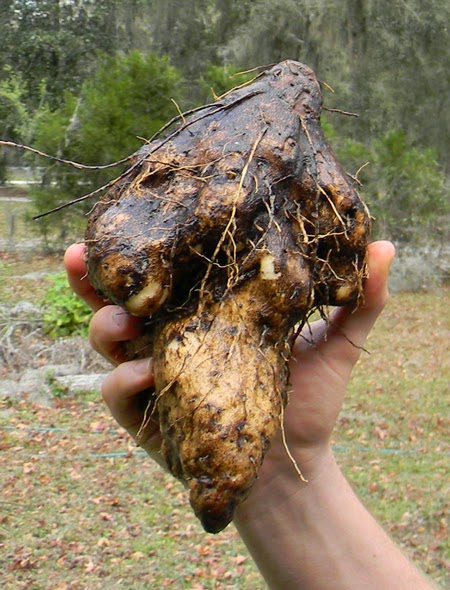
It was delicious.
Speaking of wild foraging, the invasive Dioscorea bulbifera or “air potato” can be found all over the place but it’s not safe to eat. Most wild strains will mess you up and there’s no safe way to figure out which, if any, you can eat. The root above, however, is Dioscorea alata and those are always edible. I found it growing right near a huge patch of non-edible Dioscorea bulbifera and identified it by its leaves and dangling bulbils. Here’s how to tell the difference:
Since yams are a perennial crop, you can simply plant them one year and then dig them a year or three later when you’re hungry. Look at these:
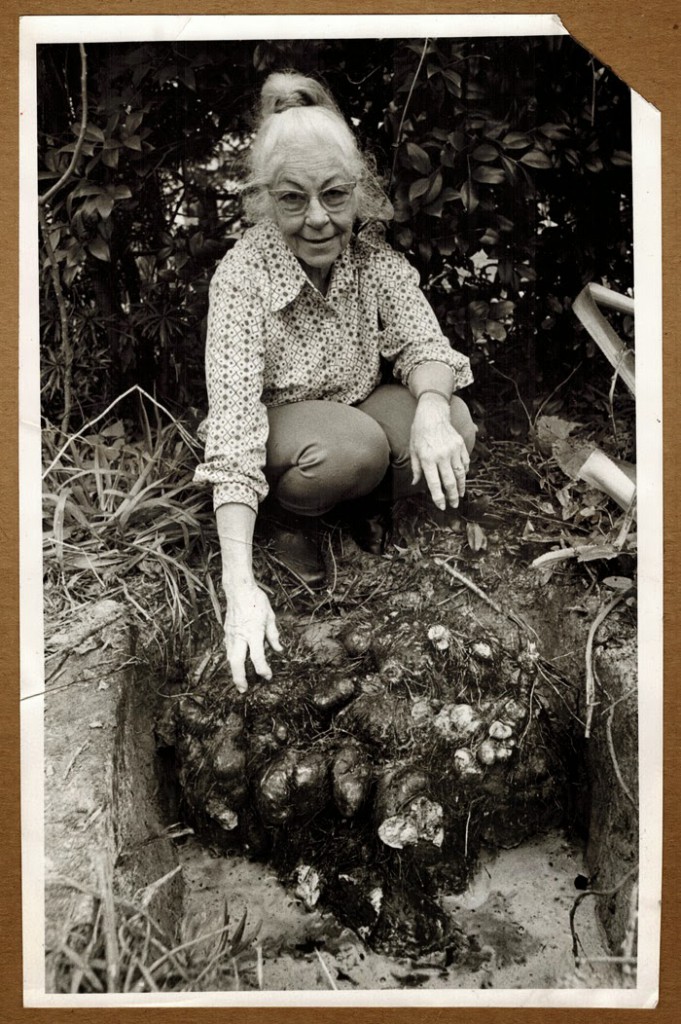
You can bet that’s not just one year’s growth.
(That’s an old newspaper photo I own of St. Pete resident Helen Parkey back in the 70s. I would love to have more information about her or her family, but I haven’t had any luck.)
I usually dig yams when they’re two years old, though I got some pretty big 1-year yams this year (again, in my nicely tended garden).
Cooking Yams
I cook yams just like white potatoes, though I find they cook faster and brown up nicer than potatoes will.
Once you know how to grow yams, you’ll be eating ’em all the time.
Yams also make wonderful roots for the crockpot and really good French fries. I also really like them shredded with a cheese grater and fried into hashbrowns – you just have to be careful, though, as some varieties are high in oxalic acid and can scratch your throat.
Here’s how Rachel prepares yams and adds them to stew:
Note the gloves!
There’s also a yam dessert made from the purple ube yam (a variant of Dioscorea alata) I hope to make soon. Check this out:
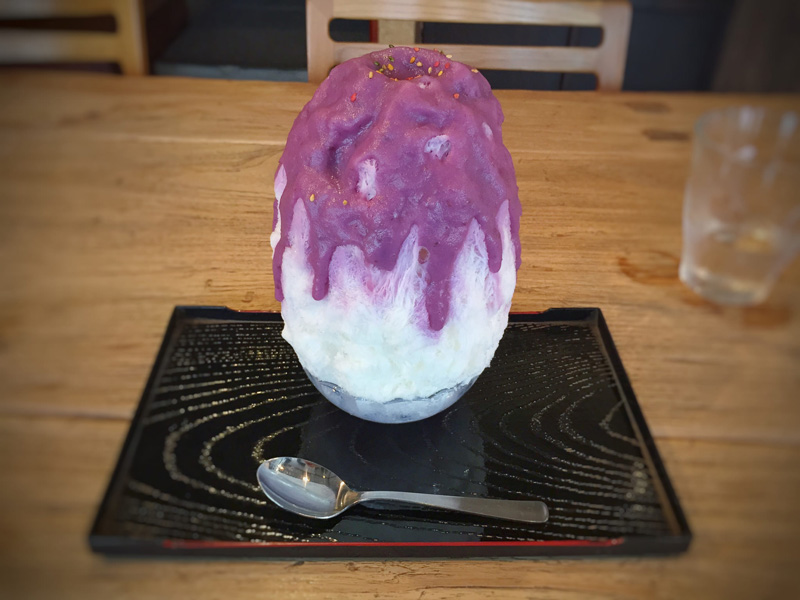
I don’t know what that tastes like but I want to eat it.
Wash them well, then wear gloves as you peel them. Once they are peeled, chop them up and cook until fork-tender. They are very good in soups and stews and can also be boiled and used like mashed potatoes.
Storing Yams
Yams keep pretty well on the counter. Unlike potatoes, you don’t have to worry about them greening up and poisoning you. If you store them under moist conditions, they’ll start growing roots. I left some in a plastic bag once and they did just that, so I ended up chopping them up and planting them instead of putting them on the table for dinner.
The best place to keep yams is right in the ground, then you can dig and eat them as needed.
If you have a great big root, you can actually break or cut pieces off of it and the cuts will dry up pretty well without ruining the rest of the root.
This is good when you have a 40lb monster to consume.
Conclusion
If you can find yams to grow, grow them! This is my top survival root for tropical and subtropical regions. Growing yams is easy and the roots taste great.
Now that I’ve told you how to grow yams, hunt down some roots or bulbils and get planting!
SPUDOMETER RATING: 5 SPUDS!

Name: Yams, Chinese yams, ube, name, etc.
Latin Name: Dioscorea spp.
Type: Vining perennial
Nitrogen Fixer: No
Medicinal: Some species
Cold-hardy: No, though roots live through freezes
Exposure: Full sun/part shade
Part Used: Roots, bulbils on some species
Propagation: Roots, bulbils, cuttings
Taste: Very good
Method of preparation: Baked, fried, stewed
Storability: Excellent in ground, good on the counter
Ease of growing: Very easy
Nutrition: Low – mostly just carbohydrates
Recognizability: Low
Availability: Low


61 comments
I bought some “purple sweet potatoes” at the farmers market last weekend that I think might actually be ube. The skin’s all wrong. I’m letting them sprout, I’m pretty sure I’ll be able to tell the difference once I see the leaves. Is there another way to tell the difference between a ube yam and a purple sweet potato?
The ubes usually are rougher, with almost an elephant skin type of look to them. Either way, you’ll have something cool.
Come down here and loot in the next week or so.
I just ordered some dioscorea alata off eBay and will put them in the ground when they get here.
Would I do better to start them in a pot and put them underneath a tree to climb up or just put them in the ground under the tree?
I don’t have any trellis or fences for them to climb.
Link here: http://www.ebay.com/itm/252244647247
Hi
I am working in Papua New Guinea. They love yams there too! It is a spooky sight seeing a fields of very high rickety looking bamboo poles to support the yam vines, cemetery like look. Anyway …
I was wondering whether “layering” techniques can be applied to the yam vine to increase root tuber, such as you would with a sprawling sweet potato vine? So maybe layering it a little before then allowing it to climb the pole.
Cheers
Gregg
Gregg – please take photos and send them so I can post! That method of cultivation sounds amazing. Definitely want to see it.
Yams don’t root all that easily out of the vine and they always want to go up, up, up. I have started them via cuttings, but that doesn’t help the root development. The most exciting varieties are the ones that produce edible aerial tubers along with the below-ground roots. I think more research on those would be valuable. Thanks for stopping by. Send photos! -DTG
Could Dioscorea Alata be grown with protection in colder climates?
It would probably grow to USDA zone 8. I know it lives in 9. Colder than that, though, I would grow Dioscorea polystachya.
Well, I foolishly ignored your advice and tried to pull off D. Alata in my zone 6 Illinois garden. Got a tiny little tuber. It actually tasted pretty good though.
Hey – that is better than nothing!
I leave in Florida and have been trying to grow yam for a while. So far, I only have a little success growing them in pot. two years ago I tried propagating but made the mistake of starting them in January which was too cold. Last year, I had a little success and enjoyed some. I find that one way to preserve them is to peel and vacuum seal them. They do well in the freezer. Also, instead of boiling, I steam them. Thanks for sharing the ash system before planting.
You’re welcome. I haven’t tried freezing them – thanks for the tip.
Hello I live in London England after bringing some bits of yam back from China last year they are growing well and this week I dug up my first ones to eat it was wonderful.
BOB.
hi David, my name is fire I am a Jamaican and I love watching your videos!!, seen you harvest purple yam and yams makes me feel as though I was back home in Jamaica!!, love what you’re doing keep up the good job!, PS how can I get some of that buibell from you so I could plant in my garden here in Cleveland I live in Ohio but I am trying to do my garden in raise up beds and also in hoop houses My email is dwhdwheatle01@gmail.com could you tell me how I could get some of that buibell to grow some yams thank you David !!, OH you have a beautiful wife also
Ebay is a good source for various yams. I would also hunt for them in oriental markets.
I have a name yam which I am going plant using the miniset method you showed. Do you if this yam forms bulbils?
Some of them do but many do not. Give it a try and see.
David: I live in coastal Mobile, AL, zone 8b and I planted “purple yam” last year that I purchased at a local oriental food market. The vines came up and looked gorgeous until the frost nipped them back in December. We did have a rather cold winter this year with a few nights dipping down into the high teens. Anyway, I have been excited about seeing my vines come back up but as of yet I have not seen any live action. I figured it would be about time for the vines to appear since the Eddoes are sprouting up all along the fence lines where I also planted the “purple yam”. Well needless to say curiosity got the best of me: I pulled on one of the dormant vines and it easily snapped off at the ground. I got my small spade out and dug the “purple yam” up for inspection just to see that it looked like it was literally rotting/getting soggy. What is your take on this? I am considering buying some more “purple yam” off of Ebay and trying it again but it is expensive on Ebay. The oriental market is not carrying these right now. I am really looking forward to your insight on this one. Thanks in advance for your time and consideration.
Sounds like the cold got to it. I’m sorry it rotted out – the cold was probably too much for it. They’re really tropical. Try mulching heavily when you try again. Also, if it’s really wet, the roots will rot even in the tropics. A combination of cold and rain likely did it in.
Thanks David…I appreciate the reply…love your books from Amazon.
Hey David another quick question. While looking at Ebay for Dioscorea Alata I ran across Dioscorea Trifida, the cush-cush yam. I am looking on the web and cannot find much information much less which USDA zone these will live in. Do you happen to recognize this yam and can you tell me if it will grow and survive in USDA zone 8b? Thanks again.
Yes – I’ve grown it before. 8b is pretty cold, but it may overwinter with heavy mulch.
Thanks once again Brother.
Hi David, I live in zone 4b of the US and was wondering if it would be possible to grow Chinese yam. I bought a small chunk from the Asian market and it ended up sprouting up a super long purple vine. Would it be able to grow properly in the zone I live in?
Probably not easily, but you might be able to keep it alive by planting right up against the south-facing wall of your house and mulching it over the winter.
So you are saying that the air potatoes , the little things that look like miniature irish potatoes are not edible ?
It’s not quite that simple. The wild Dioscorea bulbifera bulbils in Florida are considered poisonous. That’s the most common “air potato.” They have a cousin that grows in the same region, Dioscorea alata, which has edible bulbils, though they’re usually too small to bother with. The roots on those are much better. D. bulbifera, though, unless it’s a cultivated variety known to be non-poisonous, is not safe to harvest and eat.
Good Morning David: Please clear something up for me. You are saying that the Bulbifera variety has both edible and non-edible varieties? If I am not mistaken your friend, Grower Jim, sells a Bulbifera variety that looks like a space rock that is supposedly edible. I purchased 1 of these last year but it never sprouted. Would like to hear your 2 cents on this. Thanks.
Yes, that is correct. There are edible varieties of D. bulbifera in cultivation, of which Grower Jim has some, and so do I. They are different from the wild forms growing around Florida. Those are bitter and poisonous.
[…] Does it Take An Avocado To… 4 Simple Ways to Get Rid of St…. The Top 5 Best Garden Hoes How To Grow Yams Growing Arrowroot Get Rid of Squirrels Florida native pawpaws: an interview with Terri […]
Okay…thanks David. I am going to order another bulbil from Jim around the winter holidays and hopefully have better success this year. My edible white and purple yams are doing well…at least the vines are growing like crazy. I had told you earlier in the year in a post above that I thought the cold snap had killed them off. Apparently they are a little more resilient than I thought…once it stayed in the mid 90s around here they popped up and started climbing. Another item that is doing well are the Eddoes along one of my filtered shaded fence rows. It also looks like cinnamon vines will be making it as a perennial. One item that I am struggling with though are the chayotes or mirlitons as the Cajuns would call them. These sprout well and vine out great for a few weeks and then all of the sudden look they just peter-out and die…sort of just wither away. I am starting to get suspicious if they are susceptible to vine borers. These vine borers take out summer squash here almost at a 100% rate.
Excellent! I have had the exact same problem with chayote – I’m not sure what is going on with them.
Thanks David…now that you have confessed with struggling with chayotes I do not feel as bad. I have probably lost 20 or so vines in 2 years. If you watch the folks on YouTube or read articles by folks in the New Orleans area they make it look as simple as dropping them on the ground, walking away and then coming back in a few months to a monstrosity of a vine laden with chayotes. Go figure…if you come across some sort of chayote growing miracle process then please keep me informed and I will be sure to do the same. Take care down in the tropics my Green Thumbed Friend. YBIC.
Yeah, I don’t get it either. I planted some last year and all of them died. I planted about a half-dozen in Florida one year and was lucky enough to get two survivors. Once they take, they grow great for me and live for years. I need to find out what the deal is. Maybe interview a chayote farmer.
I bought a generically named nyame blanco (ny being my phonetic longhand for the Spanish “N with a ~ over it,” which I can’t type on my phone)–white yam– at a Puerto Rican market in Chicago and gave it to my parents in the FL panhandle. Unfortunately they had a direct hit from Hurricane Michael Michael. Fixing the roof is more important, but my mom wrote to ask me if it will tolerate water saturated soil or if they need to just dig it up and eat it.
[…] 2 Blocks, 17 Edibles Purple Ube Yams How To Protect Moringa Trees From Frost –… How To Grow Yams The Edible Blue Mushroom: Lactarius Indigo How Long Does it Take An Avocado To… Velvet […]
Hi,
I followed your YouTube video on how to grow, I tried everything but the yam will not germinate.
Do you have an idea why this may not be growing or does it mean that the yam seed is bad?
I am just confused and this is my 3rd trial
How widely do you space yams and malanga?
About 3′ apart for yams, maybe 2′ for malanga.
First of all, Thank You for posting about one of the things you’re obviously so very passionate about! It’s really inspiring to witness!! Second, I’d like to ask, “Would you be willing to part with a few aerial tubers of your purple ube Dioscorea alata?” I’ve been searching local stores and nurseries for the “real deal” for quite some time, now. And, my luck hasn’t been so great. What’s been claimed to be this particular form has always been some other mislabeled tuber. But, I’d be willing to buy them from you and pay for postage and packing materials, as well!! If this at all interests you, would you please email me? Any response, especially if it’s in the affirmative, would be greatly appreciated!
I wish I could – I now live in Central America.
Hi,
It is interesting to see you grow yam in this part of the world. Dascorea alata is native to wider part of Africa where it is taking as meal every day. If it can grow in the cold climate that will be great. Thanks for the good job.
be careful buying seeds for yams. there is someone selling seeds for yams on etsy saying they are “mountain yams” they listed it as Dioscorea hamiltonii. upon a little searching that type puts out a cocktail of chemicals in the tubers…maybe if that’s what you want…they use it in china a lot..but they are telling people to just use it like a potato!
“contains many chemical components, such as mannan, allantoin, saponins, dopamine, batatasine, phytic acid, amino acids, glucoprotein, choline, ergosterol, campesterol and so on”
https://www.tandfonline.com/doi/full/10.1080/09540105.2019.1674786
https://www.etsy.com/listing/548940446/10-rarely-produced-seeds-mountain-yam?ref=yr_purchases
oh and I think they are lying about where they are shipping from and it’s coming from china….shame shame
adding to the above…oh and they have a listing on ebay saying they are selling purple yam seeds…the listing says this is what your plants will look like. they used the same picture for the chinese yams as for the purple yams lol 56 sold….sad
Hi David, I am trying to find out if the LEAVES of the purple yam Dioscorea Alata are toxic.
I would like to plant them so the vines can grow up the chain link fencing around my chicken yard. Since chickens will eat just about anything, I need to make sure I don’t plant anything within their reach will make them sick.
Thanks!!
I have seen chickens around them all the time without issue. I would not worry a bit.
Excellent article. David, if I have a ton of Alata bulbils I collected in the fall, how should I store them till spring? Should I just plant them now? (November), or should I just leave them In the house till spring. I don’t want them to dry up, or rot! Thanks
Hey David, when would you reccomend harvesting in zone 10a? I have some good sized yams in the ground, but I dont want to pull them if they are still growing. The foliage still looks pretty good, but we are just now getting some cool dry weather. Thanks!
Hi Dustin,
The vines should start dying back in the upcoming weeks. Even in the tropics they go dormant and do that. I would wait until they’ve yellowed and died back for the best yams possible. They put a lot of growing in at the end of the season.
Hi David
Question with Yams would it be possible to grow 3 different varieties batata/alata/bulbifera in the same area without cross pollination effecting the tubers and bulbs?
Thank you for the excellent article on growing yams. It was very helpful. 5 Stars. By Gregg L. Friedman MD
Thank you, Gregg – very glad it was helpful.
The rare 5 spuds!
Dioscorea Alata known as Rutalu in Gujarat on the West coast of India is an essential ingredient in Undhiyu which is one of the most delicious dishes I’ve ever tasted.
It’s super healthy and super tasty. I can’t recommend it enough.
https://www.carveyourcraving.com/undhiyu-recipe/
Thank you – it’s one of my favorites, but I haven’t tried it in that recipe yet.
I do grow yams and would like to connect with you. I’m in Kenya named as Francis WhatsApp for connection +254720815171.
First year growing dioscorea Alata, white yam. Real close to Columbia SC. I planted some bulbils from etsy early spring.. I harvested one and it was about the size of a giant cauliflower. I’m pleased! I even grew a few bags of some cassava! I’m shaking the rules up here in “schizo-weather” south carolina.
Very good! Nice work.
[…] True yams are the perfect survival root crop for Florida. […]
Hi! I’m from South Louisiana. I’m curious if you can use pines for a living trellis? How acidic is the soil underneath after being mulched with its own pine needles for years? Of course our soil is sandy and acidic anyway… I’m trying to think of ways the large pines all over my yard could be useful.
I wrote an answer for you: https://thesurvivalgardener.com/can-you-use-pines-as-a-living-yam-trellis/
Comments are closed.