The elusive microclimate. I’ve stalked it for years.
As winter creeps closer, I’ll soon be preparing my cassava and other tropical plants so they can carry on into next season.
Two years ago I planted out a half-dozen small papaya trees in the summer, interspersing them around the yard. When a solid freeze came, however, they melted into papaya-tree slush.
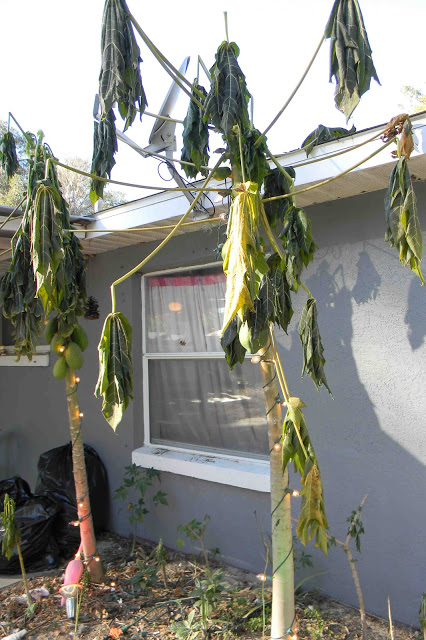
A few papayas were kept in pots on my south-facing porch – those survived. I planted them along the south wall of my house in the spring and they reached about 10′ tall and bore me some fruit before the chill stopped their growth… and the frost lopped off their tops. After it hit, they looked like this:

This microclimate wasn’t quite good enough for these papaya.
In the spring they came back from their bases and the one on the right is setting small fruit again. It’s likely too late to be much good, though.
This spring, after surveying the damage, I planted more papayas against the wall – this time right next to the concrete. Those are now bearing large fruit and will likely give me something before their decapitation by cold. It’s better than nothing. I need a smaller cultivar so I can manage to protect the plants better.
There are different ways to “zone push” and grow things where they won’t normally survive. Rocks and water are used by Sepp Holzer to grow cold-sensitive crops in the Alps. Both hold heat and moderate harsh temperatures thanks to their thermal mass.
Last year I created two passive heaters for one of my small guava trees – a pair of large gin bottles filled with water and painted black. I placed them, along with a ring of stones, beneath the 2’ canopy of the recently-planted tree, hoping to keep it just a little warmer during the upcoming freezes. The poor bugger froze to the ground anyhow. The coldness of the vacuum above is hard to beat. Nothing kills plants like a wide-open sky on a freezing night. The heat is sucked away into the void, gin-bottles or no.
Other ways of fighting the cold include mounds, warm compost piles, south-facing walls, pavement, tree canopies and windbreaks. All I need is one more zone, then I’ll stop. Just one more zone…
A helpful article is here:
http://www.gardenguides.com/582-combat-zone-envy-make-microclimates.html

3 comments
I've suffered from zone envy my entire life! And tried it all…string lights, buckets of water, smudge pots, and even nice fleece blankets! It works to an extent, but almost impossible to protect everything I've got growing. Then there's always that month of perfect spring weather, then poof: surprise frost coming my way. I'd love to grow dragonfruit outdoors……
One other thing – looks like you're in N FL somewhere as well – anything cool working for you there that shouldn't be?
Yeah – same here. I've got way too many things to protect. I always lose something. I am growing Starfruit, coffee, pineapples and a few other things by utilizing my greenhouse… but that's totally cheating.
I've been disappointed again and again by my zone-pushing efforts, but I keep trying. If I had a swimming pool, I'd build a raft garden and float it in the middle. Bet I could pull off papaya then!
Comments are closed.