
Yesterday I received this comment from a reader seeking survival foods for Tennessee that he can plant and forget in his woods:

It’s somewhat unfortunate that the land is timberland, since Tennessee is home to a wide range of wild survival foods such as hickory nuts, acorns, roots, shoots, berries and greens. The woods of Tennessee are generally rich with foraging opportunity. I’ve found many black walnuts, persimmons, blackberries and other great snacks while hiking. There are also native pawpaws, allegedly, but I’ve never been lucky enough to find any.
My friend Dr. Mom has an excellent blog on foraging in Tennessee that everyone in that climate should be reading. I met her a couple of years ago and she’s the real deal. Knows her stuff, plus she’s funny.
But back to the question: what survival foods can be grown on timberland in Tennessee without care? Here are my thoughts.
Wild Survival Foods For Tennessee
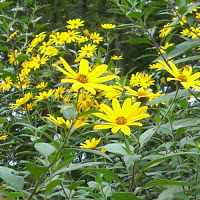
My tip-top suggestion for a survival crop you can plant and forget: Jerusalem artichokes. A sunny spot with some decent soil is all you need. I write quite a bit about their usefulness as an emergency survival food in my new book Grow or Die: The Good Guide to Survival Gardening.
They need to be planted now until any time before it warms up in March and the tubers start deteriorating. I took NO care of my Jerusalem artichokes in Tennessee and they flourished, producing buckets of tubers in my backyard outside the main cultivated garden areas.
After Jerusalem artichokes, I would plant chestnuts everywhere. Though blight-free varieties are expensive, you can sometimes have them shipped bare-root for planting. Check out Chestnut Hill Tree Farm and their Dunstan chestnut. Chestnut trees will often start setting nuts in as little as three years and yields continue to increase for a long time. They’re an excellent and healthy source of survival calories.
Other tree nuts to consider are black walnuts, hazelnuts, pecans and improved hickory varieties.
Furthermore, I’d start adding edible fruiting species such as persimmons and pawpaws if I could get my hands on them at a good price. Persimmons can often be acquired for next-to-nothing from forestry departments.
Another fruit tree I’d put everywhere: the mulberry. White, red, black – just plant ’em all over. Great fruit and highly productive.
As for potatoes and peanuts: my bet is that you won’t get a lot of yield on either but it’s worth trying anyhow. You never know. Potatoes are really susceptible to getting diseases when they remain in the same location, plus they’re likely to be overwhelmed by weeds. I’ve had peanuts come back from seed multiple times in a row but never harvested them to eat because I was too busy with high-yielding crops like Seminole pumpkins and sweet potatoes.
But what about the wild hogs?
I would keep those hogs fed. They might end up being your top survival food. Adding in tree crops will give them forage and you might also through around some wildlife seed mixes just for the heck of it.
There’s a risk that they’ll eat all of your Jerusalem artichokes, but hopefully not. If they do, you can trade those roots for bacon.
The tree crops should be fine, though they take a little longer to get going.
Good luck.
If anyone else has some suggestions for wild survival foods Steve can plant in his climate, please let him know in the comments section!

15 comments
Maybe some medicinal plants too, like echinacea, plantain (weed, not the banana-like thing), jewelweed, marshmallow, etc.? There are quite a few that are native and would probably do well. Maybe elderberry?
White Oak acorns are a plentiful food source in the area. In fact the abundance of white oak trees in middle Tennessee is why people travel here to hunt deer. People swear the deer meat in Tennessee is less gamey in taste but this is related to the low amount of tannins in white oak acorns. Being lower in tannins makes processing them much easier. Upon collection either freeze or crack them open immediately. Some of the acorns will have weevils so if you leave them in a bucket for a week the weevils will destroy them ALL. After opening discard any discolored(black/moldy) acorn nuts. Take the shelled nuts and boil until the water is an opaque brown. It is important that you have more water boiling to replace the browned water. If you pour cool or room temp water on them it will lock the tannins in and the acorns will taste horrible. Continue this boiling step until the water is clear/mostly clear. White oak acorns are low in tannins so on average I change the water 5-6 times but this can differentiate from region to region. From here dehydrate them in a dehydrator at 130 degrees F until crispy and dry or roast them at 375 degrees F for 10-15 min. If you roast them you can eat them from there. If you dehydrated them then crush them into a powder. This powder makes a nutritious porridge with warm water and wild grapes. There are also recipes to make breads with acorns flour. Also avoid acorns with holes in the shells.
Tennessee has a lot of rain… inoculate all your dead trees with mushrooms, oysters, chicken of the woods, etc… then look for ways to get morels, and chantrells to grow on the ground, and corals are great too… I am sure there are others – these are what I know.
And while we are talking food from trees don’t forget acorns… And why not a wild apple or two and pears are surviving on every old homestead even better than apples… Look for chestnuts I find them and wild blueberries too. I see seedling peaches along the roads and believe they are a possibility but they don’t bear every year.
I live here and believe what David wrote was good – these are the ideas rolling in my mind; That I keep in mind as I garden and forage…
Love it. Great suggestion.
David,
I’m going to send this to Lew Rockwell and see if we can get some more “cross-pollination” between like-minded people.
Thank you. I have written a few posts for him before – great guy.
Thank you for the excellent information. Possibly will plant some of that food near the house where I am.
I think no disasters will happen in a way that it will be difficult for people to find food and I think finding food in the wilderness or growing food in an easy way is something that I would like to do.
Really love that there are people who tell other people how to find and grow food and all the best to you,
M
There is a yearly tree day in TN as well. The TN Tree Day is an event where you preorder baby trees for $2.49-$4.99 for 1-3 foot trees and pick them up on a day in March to plant on your property. Depending on your pick up location, varieties include: elderberry, bald cypress, hazelnut, nuttall, paw paw, redbud, red mulberry, sycamore, buttonbush, indigo bush, northern red oak, southern red oak, persimmon, eastern white pine, staghorn sumac, wild plum, and tulip poplar. https://www.tectn.org/tennesseetreeday.html
An overlooked one is Sumac (Not poison sumac which grows in swampy areas, but winged/staghorn sumac which likes uphill areas). It grows like a weed, and makes excellent jams and beverages. You can also smoke the leaves like tobacco!
Also, elderberry. You can often find plants to take cuttings from near ditches and creeks. I’m on high alert every time I drive over a bridge in the woods in Tennessee.
Sumac I find to be too much trouble to do much with, but the elderberries are always a good find in my book.
Hey i just wanted to tell you that if you are ever looking for pawpaws Overton Park here in Memphis has one of the largest groves I’ve ever seen!
That is awesome – thank you, Steven. Would be great to get seeds from those and grow more around the state.
Check with your local college agriculture extension. Quite a few off free native edible plants and sometimes even trees.
Excited to start this journey
[…] https://www.thesurvivalgardener.com/survival-foods-tennessee/ […]
Comments are closed.