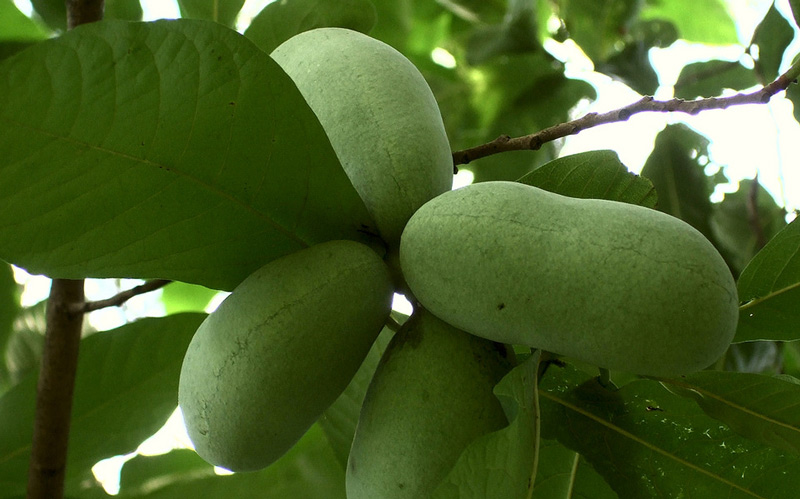
Maria has questions about how long it takes a pawpaw tree to produce fruit from seed (note that she is asking about Asimina triloba, not the tropical “pawpaw” Carica papaya):
“I read with interest how to grow pawpaw from seeds. Nowhere is mentioned how long does it take to produce fruit. I live in southern Ontario and don’t know any place with pawpaw fruit, we never eat it either. Local nursery is selling a plant about 3 ft tall ($40), must be 2 to 3 years old. They told me it will take another 6 to 10 years to produce fruit. We may not be around in 10 years therefore I was reluctant to buy the plant. The plant is common pawpaw and they suggested to get another variety from somewhere else as 2 trees are need it. It’s disappointing that knowledge of such a big nursery is so limited to a fruit tree common to southern Ontario. Should I buy the plant and when it blooms (how many years?) try to cross pollinate as suggested in your article. Can I pollinate from bloom to bloom or I need another tree?”
Great questions, Maria.
So How Long Does it Take for a Seedling PawPaw Tree to Bear Fruit?
According to a presentation by Patrick Byers at the University of Missouri:
Getting Your PawPaw to Fruit Faster
“Poor pollination has always plagued the pawpaw in nature, and the problem has followed them into domestication. Pawpaw flowers are perfect, in that they have both male and female reproduction parts, but they are not self-pollinating. The flowers are also protogynaus, i.e., the female stigma matures and is no longer receptive when the male pollen is shed. In addition pawpaws are self-incompatible, requiring cross pollination from another unrelated pawpaw tree.Bees show no interest in pawpaw flowers. The task of pollenization is left to unenthusiastic species of flies and beetles. A better solution for the home gardener is to hand pollinate, using a small, soft artist’s brush to transfer pollen to the stigma. Pollen is ripe for gathering when the ball of anthers is brownish in color, loose and friable. Pollen grains should appear as small beige-colored particles on the brush hairs. The stigma is receptive when the tips of the pistils are green, glossy and sticky, and the anther ball is firm and greenish to light yellow in color.”
I had a Florida pawpaw variety (Asimina parviflora) bloom and set fruit at the young age of three, but that isn’t all that common for the common pawpaw.

16 comments
I have a small established grove of 15 Paw Paw trees. Our Paw Paw trees have done better in full sun vs. our shaded trees. Where we live in south west Ohio, Paw Paws are abundant. We had a bumper crop of 4″-6″ fruits this year. We gathered around 130 pounds of fruit.
Thank you,
Janel Terrell
Yes! They produce more in sun – that is a good point to make. For limited space, some shade – but maximum production, sun.
And GREAT HARVEST! What a blessing.
How would they grow in Florida? I don’t see them here…
Asimina triloba grows well even south of Gainesville. Asimina parviflora and other Florida species go even farther south in the state.
We picked wild pawpaw for the first time this year. The fruit is amazing. I look forward to the grafted trees in our front yard producing in the next year or two.
Can anyone determine the gender of the seed, male or female, by the shape of the seed of the paw paw fruit? Some appear rounded while others appear elongated like a football.
We live in upstate central NY (think Syracuse). We have had two paw paw trees for a 10 years or so. Bought them from a reputable nursery. One of them has been producing abundant fruit every year. The other is smaller and does not produce any fruit even though it does flower in the spring. Is there some reason why the smaller tree does not produce fruit? Thanks in advance for any thoughts or advice on this situation.
Sounds like a pollination issue to me. You might try hand-pollinating, or the old “hang up some rotten chicken by the tree” method.
Just learned about Paw Paw trees today.
We were given some seeds that came from Paw Paws that grew in Boone, NC, which is in the BlueRidge Mountains. I live about 8 miles away in Blowing Rock, NC. We were told to plant them now today is 11-08-19. How many seed do you need and how close together should they be? I’m fairly sure they came from the same trees that we were told now appx. 20 feet tall.
I grew up singing the song ‘Picking up Paw Paws, put them in a basket…and I can’t recall the remaining words. However I never knew what a Paw Paw was. I’m fascinated with them and want to grow some. I will be 80 next Birthday and was wondering if it would be best to give the seeds to my son and / daughter. I would love to see a tree grow and bear fruit, but I don’t know if that will happen. Any ideas out there from you knowledgeable folks? Thanks, Mary
I usually plant a few seeds together in case some don’t come up. If they all come up, pick your favorite when they’re a foot tall or so and remove the others. Good luck!
Enjoyed reading the comments from all of you having Paw Paw trees. Hope to hear from some of you. Thanks! Mary
Hi, I’m about to move from southern Illinois, where paw paws are abundant, to Maine where I want to either plant them in my yard or out in nature. How do I keep the seeds viable from now (Sept) to May?
We live in Annapolis, Maryland. I planted one paw paw in 2018 that I bought at a garden center, and three more in 2019 that came from a gentleman on Maryland’s Eastern Shore. All are still alive. I am grateful for that at least. No flowers yet, but I am hoping that next year (2022) will bring fruit
That is really cool. Watch for blooms this spring – if the arrive and you can hand-pollinate, you are more likely to get fruit.
Don’t think I’ve ever seen a pawpaw here in south Mississippi much less ever ate one!
However, I do recall a childhood song about… “ way down yonder in the paw paw patch”
Picking up paw paws, putting them in your pocket, picking up paw paws, putting them in your pocket, picking up paw paws, putting them in your pocket ,way down yonder in the paw paw patch!!!! Lol
I’ve always wondered whether these would grow in NE Ohio. I haven’t ever seen one in nature here.
Comments are closed.