
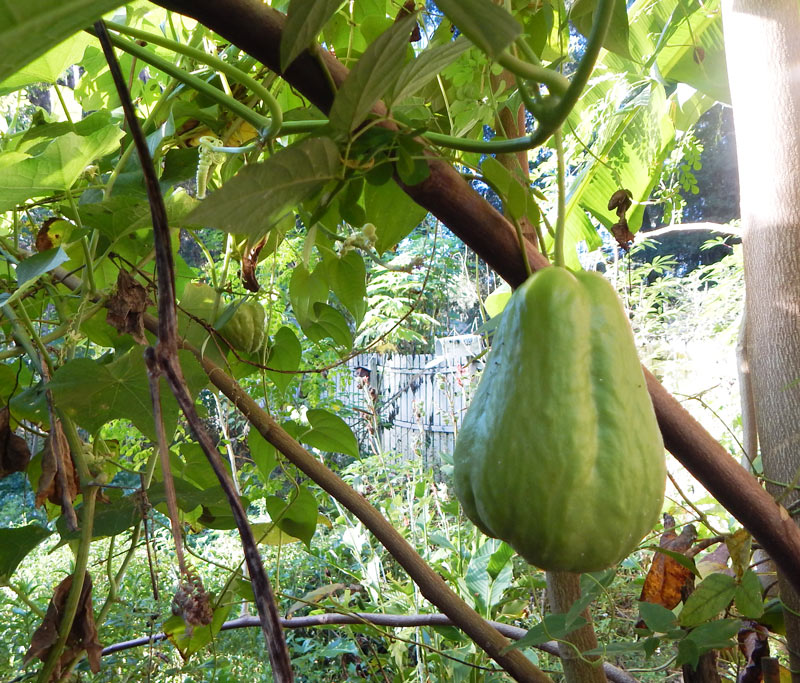
Hey! Let’s do a list post! How about “8 Reasons Why You Should be Growing Chayote Squash?”
Oh shoot. Now I have to come up with eight reasons, which is a number I picked arbitrarily. That shouldn’t be hard, though, as chayote really is an excellent addition to the garden. Also known as christophine and mirliton, they are a Mesoamerican crop which is now available around the world. Costa Rica exports tons of them to the EU and the US every year as the taste for this tropical squash-that-doesn’t-taste-like-a-squash has grown.
Ready? Let’s see if I can come up with eight reasons for growing chayote squash… here goes…
1. Chayote is Productive
No lie! This squash is likely to be the star of your garden in 2017 if you get them planted this spring.
Here’s a photo-manipulated shot of a bag of them I picked in my North Florida garden at the beginning of 2016, just before the first frost of the winter (which was a very late one – January!):
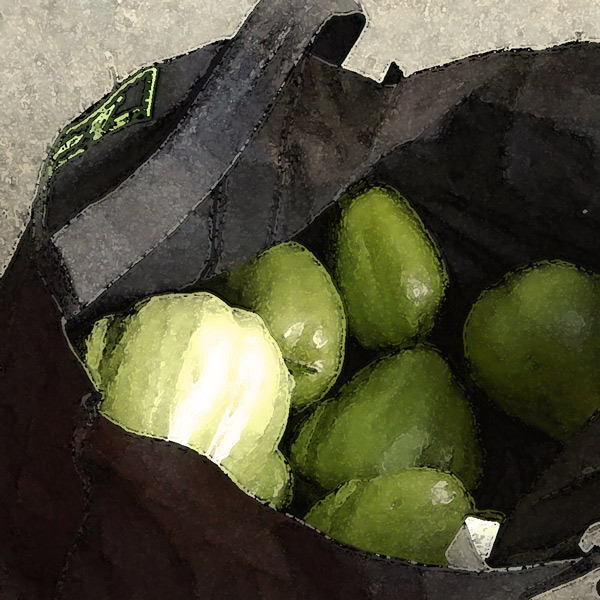
It looks artistic, doesn’t it? I added an “artistic” filter in Photoshop!
You can see me harvesting these squash in this video (along with a few other goodies):
They are a wonderfully productive plant – but don’t think this productivity lasts for only one gardening year. Oh no – the story gets better!
2. Chayote are Perennial
That means they come back year after year. Look at this one growing back:
I love perennial vegetables. (You might be surprised at how many great ones there are – if you want to dive down the perennial rabbit hole, Eric Toensmeier’s excellent book Perennial Vegetables will get you dreaming.)
If you live in a colder climate, mulch over chayote’s roots to make sure they don’t freeze in the winter. My bet is you’ll be able to keep them going all the way into zone 7 if you’re clever with frost protection.
3. Chayote Taste Good
There is a highly productive vegetable that starts with a “z” which I don’t wish to mention, as it is a hateful and vile thing.
People grow this, then throw them away.
Unlike that abomination, chayote are good enough that you’ll want to eat them. They are much like a dense cucumber and some call them a “vegetable pear.” If you play pretend, they are somewhat like a mild pear but without the grittiness.
How do you eat them? I need to make a another point, obviously, or I won’t hit eight. So…
4. Chayote are Versatile in the Kitchen
Chayote can be sliced and eaten raw like their cousin the cucumber, or they can be peeled and cooked. we discovered through experience that if you don’t peel them the skins get quite tough in cooking.
Chayote can be made into pickles and relish and can also be sauteed. One of my favorite ways to eat them is right off the vine, like a fruit.
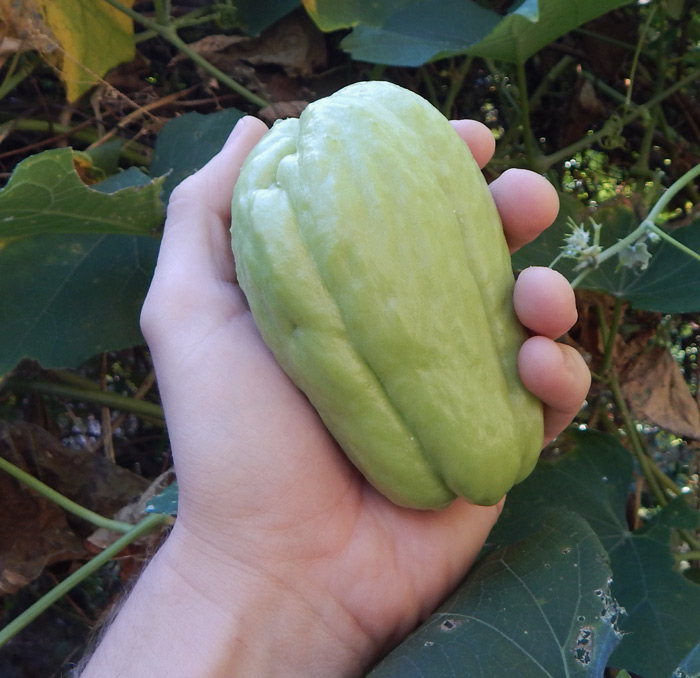
They are denser than a cucumber and hold up better in cooking. They’ll also absorb the flavor of whatever you cook them in, so they’re a good filler for the pot.
5. Chayote Shoots are Delicious
This is something I discovered while I was visiting the H.E.A.R.T. gardens in Lake Wales and touring the plants with my friend Josh Jamison.
“Have you ever eaten the shoots?” he asked, when I recognized chayote growing on a trellis.
“No,” I said, “I heard they were edible but never tried them.”
“Here,” he said, breaking one off. “You have to try one.”
I did. “These are amazing!” I said.
He grinned. “They really are good – I’m growing this trellis just for the shoots!”
I was impressed. They’re good in the way asparagus is good. Chayote shoots are a mix of subtle flavors, nutty, fresh, green, sweet, delicious.
6. Chayote is Easy to Grow
Some vegetables – like tomatoes – are technically a perennial but practically speaking are an annual. Unlike these fair weather perennials, chayote sticks around happily. I’ve had few problems with insects, disease or nutritional deficiencies… they just like to grow. Strangely, though, I have had multiple chayote rot when they were planted, instead of grow. I found out what I was doing wrong, however, and now plant them differently.
In a video I posted yesterday, I show you how to plant chayote to give them a better success rate from the beginning.
Planting them on their side, not all the way in the ground, seems to be the best way to do it.
7. Chayote are Novel
There is such a thing as garden bragging rights. In fact, once you reach Super Elite Gardener Status(TM), you start competing with other gardeners to see who has the wildest and weirdest things growing.
Super Elite Gardener #1: “So… did you see my mouse melons?”
Super Elite Gardener #2: (yawns) “Oh yeah. I grew those, like, five years ago.”
Super Elite Gardener #1: “Of course. Everyone grows them. But I know you used my guest bathroom earlier… notice anything… interesting… in there?”
Super Elite Gardener #2: “Uh…”
Super Elite Gardener #1: “You did, didn’t you? Yes, you did. Tell me what it was.”
Super Elite Gardener #2: “It was… a… 30-foot…
Super Elite Gardener #1: “Yeeeeeeeessssss?”
Super Elite Gardener #2: “…or maybe longer…”
Super Elite Gardener #1: “Say it.”
Super Elite Gardener #2: “…vanilla orchid with pods on it.”
Super Elite Gardener #1: “Which you wouldn’t think was anything, would you, if it were just a NORMAL vanilla orchid, right? Why is this one so special? Tell me.”
Super Elite Gardener #2: “I’d rather not say.”
Super Elite Gardener #1: “That’s because I win, don’t I?”
Super Elite Gardener #2: “Fine!” (sobs) “You win! It was a VARIEGATED 30-foot-plus vanilla orchid with pods on it growing 1200 miles from the tropics! You win! I hate you!”
Chayote may not be at that level, but it will put you ahead of the typical backyard vegetable gardener.
8. Chayote Vines Will Climb on What’s Available
Unlike some vegetables that need to be tied up carefully and supported well, chayote will happily cover whatever is available.
I’ve seen them growing 40 feet up in oak trees. They’ll climb towards the sunshine and put fruit way up in the air. This is good and bad, of course. It’s great that they are so scrappy, but it’s hard to harvest fruit that high in the air.
If you have a chain link fence, a small tree you don’t care about or a rotting garden shed… plant chayote next to it and let them run. They’ll turn that support into a beautiful green mass of vines in a season. Growing chayote squash over eyesores isn’t a bad idea, actually. Got a burned-out car? Grow chayote on it! An ugly spouse? Chayote!
My chayote vines quite happily grew over an unproductive pomegranate tree and covered it with fruit… albeit not pomegranate fruit.
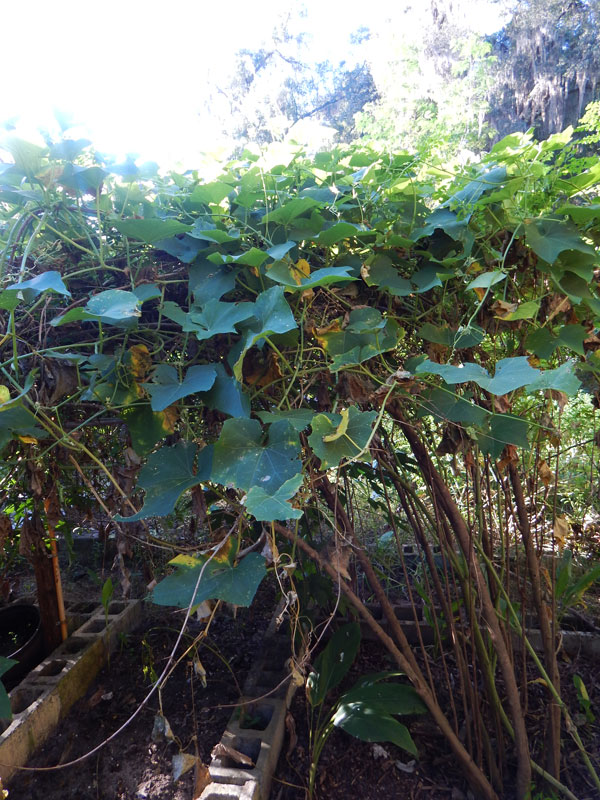
They make good shade, too, so you could plant them on an arbor over a sitting area for summer shade.
Actually… I could add a 9, too. Let’s do it!
9. (A BONUS! EXTRA POINTS!) Chayote is a Solid Survival Crop
Because of the list above, chayote is a very good addition to a survival gardening plan. Their nutritional profile is good, though they are unfortunately low in calories. The productivity makes up for low caloric yield, though, and they’re a good break from MREs, spam and canned beans!
Now that I made it to 9 of 8, let’s take a minute and look at growing chayote squash in your backyard (or front yard, if you’re hardcore).
Growing Chayote Squash
Growing chayote squash is easy.
First, get a few chayote from a grocery store, a fellow gardener or a farmer’s market.
Leave the fruits out on your counter for a few weeks. Eventually some of them should grow shoots out of the blossom end. (Chayote do not grow from proper seeds. Instead, the fruit surrounds a single embryo in the middle.)
Once they sprout and the vines are a few inches long, I plant them as shown in the video above.
Make sure you have something sturdy for them to climb where you plant the sprouted fruit. They’re not picky, as I said, but they are vigorous.
Chayote like full sun but will take half shade. Morning sun is the most important.
Chayote like compost, nitrogen and mulch. I fed mine with diluted urine (and sometimes undiluted) poured at the base of the plant. My bet is they’ll also appreciate calcium.
My plants produced in the fall after growing vigorously all through the spring and summer.
Have fun growing chayote squash – it’s a worthwhile vegetable to add to your survival garden.

30 comments
I agree with all 9 points! My chayote were amazingly productive in just the first year. I had chayote fruits all over the place and couldn’t cook them fast enough. I started researching recipes… they can be used in savory or sweet dishes. They’ve even been used to bulk up apple pies (this hint came from a friend in Australia.) There’s a delicious Filipino soup made with chayote, chicken and ginger (as well as other veggies you want to add to it.) Refrigerator pickles or pickle relish. I’ve done a lot of experimenting and I enjoyed eating everything I made. I truly am sorry to see chayote season end.
Pickles – I must try pickles. Thank you.
I love how we all have different ways of saying things. In Australia we refer to them as “chokos” (pronounced: choke-o’s. They’re a perennial favourite for growing over chicken coop runs. As they shade in summer and allow the sun in, during winter after they die back. Plus the chickens will eat any dropped surplus fruit. Which there will always be plenty!
I try to make my mother’s choko chutney recipe, at least twice a year – if not more. Did you know they can also be used as an apple pie filler? Or be eaten in chocolate cake? Recipe here.
Or if you want to eat them like stewed pears, try this recipe. I love to eat them this way. It’s a lot easier to grow chokos to eat like a dessert pear, than it is to grow a pear tree! And a lot quicker to start producing. Only downside, is that it uses a bit of sugar. But if you’re okay with that, choko’s make awesome pears! Not confusing at all. ;)
I agree with your list.
Awesome!
I like the chicken run idea. Very good!
I don’t think I’ve ever seen a Chayote around these parts. Can they be grown as an annual up here in zone 5, I wonder?
One summer I made a promise to use every zucchini that grew in my garden. And I kept it up, too, until my family literally begged me to stop. But those posts are still some of the most popular I’ve ever written on my blog, as other frugal gardeners desperately google-search new ways to disguise zucchini as palatable food.
I think you’d have a very hard time growing them in zone 5. Just too cold and they take too long to get going.
Zucchini isn’t a food. I think it’s great that the posts were popular, though. Great idea to chase a topic like that.
My Chayote grows in Singapore here but I dont have enough sun to get fruits yet.. However I now pluck the young shoots and used them in any stir fry and they are delicious and contains lots of nutrients.
The shoots are amazing. A great vegetable by themselves.
These are called cho-chos n Jamaica, where I grew up. Here in S. FL, they don’t do well because of the nematodes. I’ve heard you can grow them in the compost pile to solve that, but I’ve had no luck, unfortunately.
Nematodes didn’t get mine in North Florida but I did grow them in a lot of mulch and compost.
Growing up in Grenada, my dad grew christophine all year round. I loved them. My mom would cook them in meat dishes or soups or make a salad with them. It can also be grated raw, pour some water over and let sit in the fridge overnight. Drink a glass before every meal for a refreshing, cool drink. I usually let it sit for a few minutes before drinking. Curry chayote with caribbean sweet potatoes are the best. I have to try pickling them. Great post on one of my favorite veggies.
If I grew up in a place like Grenada, I don’t think I’d ever leave! I like the drink idea. Never heard of that. And curry is always a favorite in our house.
My favorite way to fix these is fried. My wife boils/steams them first then slices them lengthways, breads and fries them. Never enough at the time for my liking! They don’t do as well just frying as they burn before they get done. Will have to try the shoots, they are growing now.
That sounds delicious!
David, I see you have not met zucchini chocolate cake! It is amazing and moist, really the best use of zucchini ever!
My concern is how well to chayote tolerate wet? I am moving to the Pacific Northwest and wet is what it gets! I am thinking of starting them before we move there to give them a head start, but need to know if they will survive.
Can it be made without zucchini in it?
They need a long season. You will need to start them indoors months ahead – may need a greenhouse to get them to production.
I read about Chayotes a few years ago and they have been on my list to try but I haven’t been successful in find any. I live outside of Gainesville, Fl. Do you know any sources?
I got the fruit in Publix.
We peel them and add them to chicken or lamb curry instead of potatoes. Absorbs the curry flavour very well
40 years ago and back, this area (Pierson Fl) had many backyard ferneries. Since ferns must have shade, some folk built shade structures from fat lighterd’ posts, rough cut 2X4 stringers and sawmill slats laid across the stringers about 4 inches apart. Some of the slat houses were acres in size. Hot summer days was bad for the ferns and the slat houses would have rosemary brush or myrtle limbs laid on top for extra shade. Since the posts were ten foot spaced, Chayotes were the best. Several old timers had them at every post and everyone who worked could have about all they wanted, free. They made excellent shade and the Chayotes would be hanging down bumping your head as the top was only about 6 foot high. I’m 62 now and just cooked up a mess night before last. Still love ’em. Fixin to plant some next spring for my new wife that came down from Maine. She won’t eat gator yet, but she liked the Chayotes fried.
That is totally awesome. I’ve seen fern shade houses running over acres before. Love the dual use.
In the Dominican Republic we add them after steamed…boiled to a pot with bit of oil…I use olive…..garlic ..onions…scramble few eggs and mix…cover few mins…..delicious.Salt and pepper to taste.Cooked pork…chicken or even with steak onions and green peppers or red peppers. I prepare a chicken veg soup that has potatoes.. Pumpkins and chayote……I dice….sliced dissolves and u can’t see.I also prepare chayote salad….in Dom rep we call it tayota….Ta…Jo..ta.Salad contains…..potato…chayote… Carrots…boiled eggs….red onions…..vinaigrette (olive oil…salt…lime juice or vinegar(red wine…white…apple cider).Love this…….enjoy!!!.
Eileen…..I can mail u few and u can plant…..eatbone or two.We have all yr round.Inlive in Manhattan… NYC.
I meant …eat one or two…..lol….
Eileen…..I can mail u few and u can plant…..eat one or two.We have all yr round.I live in Manhattan… NYC.
Hey David, great post!
I’m growing a few strains this year and the results have amazed me a lot!
I came here to see if you had written something on chayote already and found this well done piece. Keep it up, I’m a big fan of your content.
I just want to add that here in Mexico the root is eaten and sold in street markets as a delicacy, i’ve had it and it’s good. The texture reminded me of cassava, also very starchy. I think this is a bonus and might make up for the low calorie fruit, and help it rank higher as a survival crop.
Greetings from central Mexico.
Ángel.
Hi David!
Don from Vero Beach here…
As soon as Im able to get one of these to grow without it becoming an appetizer for armadillos, I was wondering if these can be eaten uncooked?…
I make a soup when I don’t feel well. Chop the peeled fruits, cook in chicken broth and a small bit of soy sauce and Chinese wine. Add in cooked rice and a small pat of butter at the end. Great for sore throat type colds or during allergy season. I guess you could leave out the butter and add in garlic and ginger too. Easy fruits to enjoy. I also seared as a side dish cooked in a bit of broth, then drain and butter with salt and pepper. Nice with chicken , and rice for a mild dinner.
[…] If you’d like more tips on how to grow chayote, here is a post with videos and other helpful hints. […]
Comments are closed.