
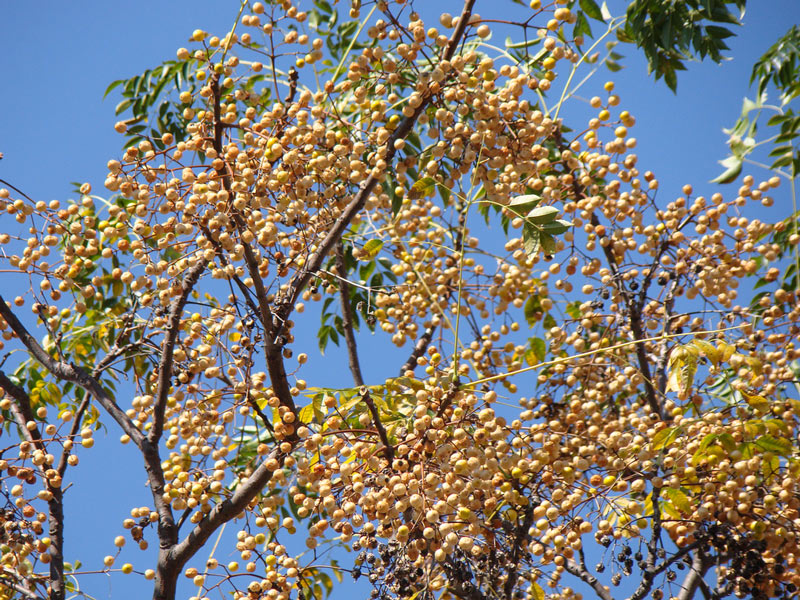
When I lived in North Florida, I was driving down the road one day and came across a fruiting tree I hadn’t seen before.
Could these fruits be edible? I wondered. I tasted one carefully and it was sweet, but I spat it out because I am always a very, very cautious naturalist.
Plants can kill you. Don’t try this at home.
After finding this tree, then noting several others along the railroad tracks, I asked around and did some searching. Eventually, I found out it was a chinaberry tree, AKA Melia azedarach.
I also found out IT’S EVIL!
“When Chinaberry was introduced into the U.S. as an ornamental its natural enemies (diseases or insects) were not brought along with it to maintain its populations at low levels. Along Florida’s road sides, in natural areas and forests, and marshes Chinaberry has the ability to grow rapidly and displace the native vegetation in those areas. Through prolific reproduction via seed as well as vegetative reproduction, it is able to shade out other species by forming a dense thicket. The leaf litter produced by Chinaberry causes the soil to become more alkaline, giving an advantage to those species that fair well in alkaline soils. Chinaberry is also believed to have allelopathic properties, prohibiting other species to colonize the area in close proximity to Chinaberry. Overall Chinaberry reduces the plant diversity in any area in which it grows.”
I left the one growing in my edible landscape project – we’ll see how allelopathic it really is.
But wait, UF is downright friendly compared to the Chinaberry write-up at the Texas Invasive Species Institute:
“These trees grow rapidly from several root sprouts and they create dense thickets where native plant species get crowded out. Chinaberry trees can create monocultures and lower biodiversity amongst native ecosystems. Also, this tree has allelopathic effects and is resistant to native insects and pathogens, making it a fierce competitor against native trees and almost impossible to eradicate with biological controls. All parts of the plant, especially the fruit are poisonous to humans, some livestock, and mammals, including cats and dogs. Symptoms post-consumption include vomiting, diarrhea, breathing difficulty or paralysis. Cattle and some birds can eat the berries without harm. The leaf litter can change the nitrogen, aluminum and alkaline levels in the soil which causes unnecessary chemical changes in the ecosystem. Moreover, bees and butterflies do not use the flower so it serves no pollinator benefit. Some studies have tried using chinaberry-based insecticides against other invasive insects; however, that is the only potential benefit of this invasive tree, which is not really enough to justify its presence in the ecosystems.”
Heavens! Lawd have mercy, I’ma getting the vapors!
Despite the bad press, Chinaberry has some good uses.
Chinaberry Tree Uses
First, it’s a relative of mahogany and has quite beautiful wood. You can see pictures at The Wood Database.
In that post, The Wood Database relates chinaberry is:
“sometimes called “Persian Lilac,” though the name usually rather refers to a hybrid lilac in the Syringa genus. Chinaberry is not closely related to true lilacs, but is rather related to the various types of Mahogany in the Meliaceae family. Chinaberry is a potentially commercially valuable timber tree throughout its natural range in Asia, though perhaps under-utilized and under-appreciated.”
There are some chunks of wood laying around at the resort from where some trees were cut a year ago. Maybe I’ll get some of it sawed up and see what it looks like for myself.
Other than wood, the tree has nice flowers and an airy growth pattern. It also grows back vigorously when cut, meaning it may be a good chop-and-drop tree, though the allelopathy might be a problem.
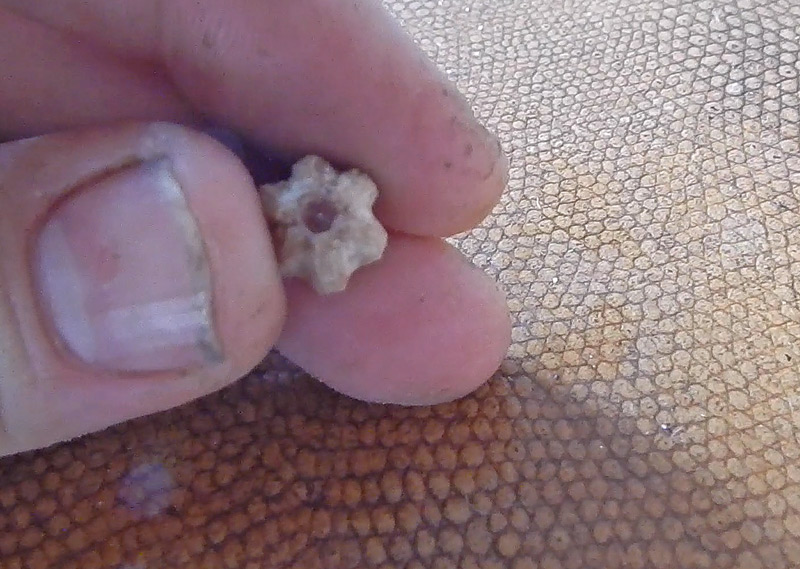
It also has very hard seeds which can be used for beads:
Overall, like many invasive species, I’d say this tree isn’t as bad as advertised.
I’m leaving the tree you can see in this video:
If it’s really terrible and the plants beneath it die, we’ll just mulch the area and wait a few years, then cut that thing down for timber.
*Image of fruiting chinaberry via https://www.flickr.com/photos/mauroguanandi/. Creative commons license.