A friend of mine raves about the versatility of vetiver grass. She has it growing here and there around her farm.
I am unfamiliar with the species, but as I’ve researched, it appears quite useful indeed. Here’s a good article over at Permaculture News:
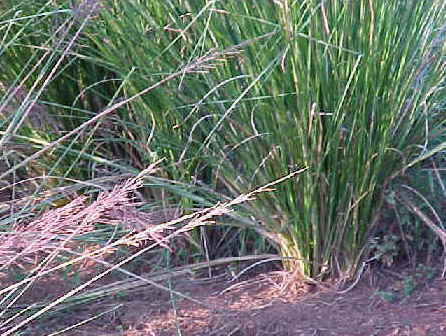
Vetiver (Vetiveria zizanoides) is a densely tufted, perennial clump grass with stiff leaf bases which overlap.

It forms narrow, dense hedges when planted along the contours of sloping land, slowing down run-off and helping the water soak into the soil rather than washing off the slope. The stiff foliage also blocks the passage of soil and debris which gradually builds up a soil terrace.
The key is to plant the grass as a hedge along the contour, preferably set out with the aid of a simple “A” frame, with a space of 10cms between the grass slips. Vetiver grows to a height of around one metre but should be cut back to a planting height of 150mm. The thatch can then be placed behind the newly planted slips to provide an instant filter to control run-off. We did this with amazing results on an urban-fringe forestry programme to control erosion on bare, decomposed granite soil on the hills above Hong Kong. The night after planting saw a very heavy tropical rainstorm. We went next morning and found that two inches of soil had been held back behind the intact grass hedge.
Vetiver is a live system, rather than engineered (bulldozers, graders, bunds, contour drains), which grows with the deposition of sediment. In Fiji, vetiver hedges which have been in position on 20 percent slopes for thirty years have built up terraces two metres high. Experimental plots in Colombia showed significant soil loss reductions using vetiver hedges, where in one year, soil losses were reduced to 1.4 tons per hectare compared to 143 tons per hectare for a bare fallow control.
Best results arise from a two metre vertical interval between hedges, but this depends on the degree of slope and the friability of the soil. On our friable soils in Hong Kong a double staggered row had the best effect. The edges of unsealed roads and drainage ditches can also be protected by vetiver.
Because of their basal density, vetiver hedges are far more effective in controlling erosion than lemongrass or hedges of trees or shrubs such as Leucanea.
It’s also used for perfumes, animal forage and medicine.
There is a ton of information on vetiver here. I could end up reading for weeks. Looks like I’ll have to plant some.

6 comments
Does it grow in sand? If so, we gotta try that. We live on a sandy slope, and erosion control is a constant concern.
Yes, definitely!
It sounds like I could plant it around my mulched beds like a border to keep the mulch in place. And of course trimming the vetiver and throwing the cuttings back in behind would add to the mulch.
Thank you, David the Good, for sharing.
Yes, I think so. And cut it regularly to make more mulch.
From the temperature range of the vertiver it looks like it will have no problem growing here in North Florida. Now I’ve got to get some and start propagating.
It grows very well in Louisiana Steve., despite it being sometimes burnt off by frosts in the winter. It needs good summer soil temperatures – 17C and above. I measured 36C soil temperature at 100mm depth in Louisiana in late June.
Comments are closed.