
These are the easiest beans to grow, ever.
Vigna unguiculata, also called the Yard-long Bean, the Snake Bean, the Asparagus Bean and various other weird names, is an Asian green bean that kicks tail in Florida. I mean, SERIOUS tail. This thing is a monster.

Bean noir
The pods aren’t really a yard long, though they are quite impressive at roughly a cubit. (Yeah, I said cubit. Look it up.)
Let’s talk about how crazy awesome these babies are.
The vines grow really long with little or no care. If you grow these, which you should, make sure you’ve got plenty of climbing room for them. A good trellis really helps them grow. Something fascinating about this plant: you can basically plant it at any warm time of the year as long as you give it enough water to get started. I planted them in mid summer and got a good crop, as well as in fall and spring. This sucker grows like a weed. I’ve even stuck seeds in the front yard and let them run across the grass and eat neighboring trees and shrubs. With zero care, they still bore beans. I once planted them in a spot that received only indirect light: they bore a large crop anyhow. Another time I planted them on a baking-hot fence. Same deal. Tons of beans.
And what beans: the taste is almost nutty. A lot of green bean flavor with overtones of roasted almond and a bit of asparagus.
Snake beans take a little while to get started. For a few weeks, they’re just cute little bean plants. And then they pull the Incredible Hulk routine on you and start reaching for the sky in a blinding green rush.
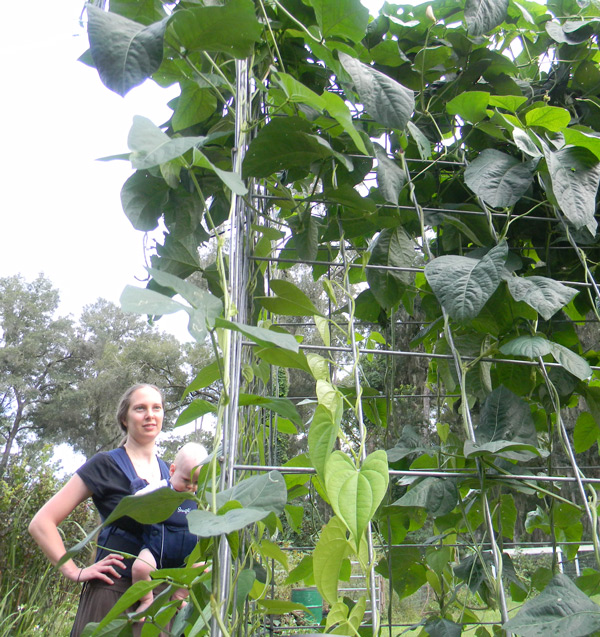
Force perspective, heck yeah. (BTW, that is NOT a bean in the middle with the heart-shaped leaves – it’s a type of yam.)
SPUDMETER SURVIVAL RATING:

5 Spuds!
SURVIVAL PLANT PROFILE:
Name: Snake bean, Yard-long bean, Asparagus bean
Latin Name: Vigna unguiculata
Type: Vining annual
Nitrogen Fixer: Yes
Medicinal: No
Cold-hardy: No
Exposure: Full sun recommended: in reality, shade too
Part Used: Leaves, small stems
Propagation: Seed
Taste: Excellent
Storability: Moderate (can or freeze as green beans)
Ease of growing: Very easy
Nutrition: High
Recognizability: Moderate
Availability: Moderate

20 comments
I love these stir fried with some olive oil and garlic – yum!
Oh yeah. Unbeatable.
If everyone planted 20 of them no one would go hungry again!
my longest bean recorded 29.5 inches long and a half inch thick on the longest vine we had est 40 ft, + or – 3 ft. Also figured out: Clip them 1/2 inch from the top of the bean(leave a small cap of bean) and it will replace them with two blossoms. Same node produced on two locations 8 sets of blossoms.
Do the math and pause, . , . , Scary huh?
I'm planting 30. Just doing my part to end world hunger.
Thirty? Goodbye world hunger. You’ll soon be running from the vines.
Someone may tell me where I buy this bean seeds, Thank You.
Southern Exposure Seed Exchange has five different types for sale here:
http://www.southernexposure.com/beans-asparagus-beans-c-3_5_62.html
I purchased mine (organic) with free shipping on eBay.
So, I'm finding many types of asparagus/snake/yard long beans online. Most places don't list by scientific name. Any suggestions on which I should go with?
So far as I know they'll all do well here, though you might buy a few types then save seeds from those that do the very, very best. Good luck.
I planted some seeds this summer that I had saved and found them in the back of my fridge. ALL germinated and they must have been five years old.
That is fantastic.
I tried growing these in South Florida this summer and have encountered serious problems with Aphids. I tried spraying the leaves daily with water, then tried a tomato spray, neem oil spray, and finally some organic insecticidal soap spray. For 3 months I have battled these bugs with no luck. They seem clean for a day only to come outside and have the entire plant covered in aphids again. They specifically attack the flowers and prevent beans from forming. I had read this would be a great vegetable to grow in the summer heat. We have had a very wet summer here. Could that be contributing to the aphid problem?
Hmm. Frustrating.
Usually when there are a lot of aphids it means that you're short on predatory insects such as ladybugs. My recommendation is to let a few good patches of random weeds grow in your yard if you haven't already. Near to the garden is good. They provide places for the aphids and the good guys that eat them… if you have a garden that's too clean, the aphids will outbreed the predators and win.
The wet summer might also be a problem. I'd also try again in a couple of months, then again next year, perhaps with a different cultivar. I had great luck in south Florida with them; however, everyone's yard and every year is different.
Good luck! I'd hate you to go without these puppies!
Are these perennial?
No, unfortunately.
Madagascar bean is a great short lived tropical/subtropical perennial bean, checkid out
https://www.succeedheirlooms.com.au/pulse-dried-bean-seeds/lima-bean-madagascar-bean.html
Hi! I just bought your Crazy Easy FL Gardening book and read it cover to cover. I am growing vegetables for the first time this year, and I live in the Orlando area. I have a few things going, but I REALLY want to plant snake beans. I’ve ordered the seeds from Southern Exposure. Here’s my question: what can I get to grow them on? I have a vinyl fence, so there’s nothing for them to grab onto. I was looking online for trellises or arbors – I’m just not sure. I’m not really big on building something myself. LOL. Any suggestions? Thanks so much for your help!
Thanks for stopping by! I’ve grown them on tipis made of sticks, old pieces of fence nailed to a couple 2×4 supports, an old bedframe, strings tied to a fence, even growing them up skinny trees will work. You’ll find something if you scavenge. They’re not picky.
[…] J L, You can grow yard-long beans, okra and Southern Peas in the summer heat, though everything will do better if you wait a couple […]
Comments are closed.