Okay… I’ve posted on before on starting fruit trees from seed… and I’ve written a bit about starting nuts here, but it’s really too juicy a topic to cover in just two little posts. The following is my do-it-yourself guide to starting a variety of trees from seed – with plenty of pictures I took of my own projects. Yes – they’re not huge trees yet – but they will be. I’ve only been at this for three years and I’m already amazed by some of the successes.
I’m madly in love with seeds. They’re cheap, readily available and could potentially grow into something amazing. The promise contained in a tiny seed is incredible.

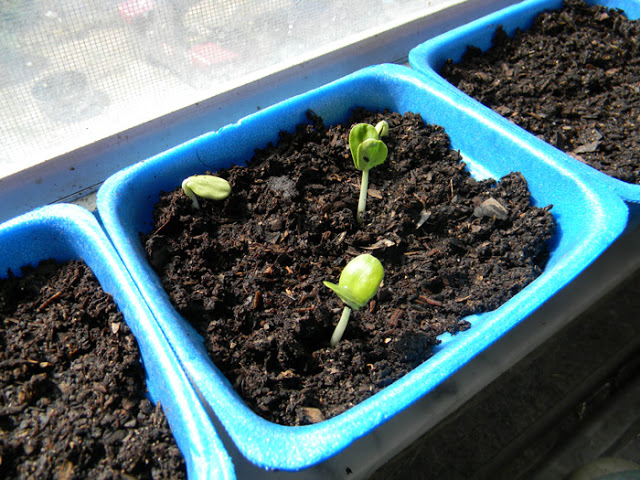
Baby carob trees sprouting in a sunny window
However, when it comes to growing trees from seed – fruit and nut trees in particular – we’re almost always told “don’t do it!!!”
Why?
“It won’t breed true!!! You’ll get tiny/bitter/nasty/worthless fruit!”
Really? When you save cabbage seed and plant them the next year, do you get tiny/bitter/nasty/worthless plants? No!
The reality is, you won’t get exactly what you started with, but most of the time, you’ll get something worthwhile. There are always genetic traits we don’t like that may pop up, but most of the time, you get something decent – or even excellent – when you plant seeds, fruit trees included.

Two-year-old citrus seedlings in a greenhouse
Unlike grafted trees, trees that grow on their own roots are often tougher and larger, if not always as productive. Grafting is very useful for commercial farms because it allows them to grow exactly the variety they want. The navel orange, for instance, is a cloned variety that’s been around for almost 200 years. The same genes… replicated ad infinitum via cuttings and grafting. It’s amazing – but in my mind, not the safest thing to rely on when you’re dealing with diseases, pests and changing climates. Where do we get new varieties with disease resistance, larger fruit, higher cold-hardiness, etc.? We get them from planting seeds and seeing what hidden gems might pop out of the plant’s genome.
Of course – this doesn’t happen overnight. Unlike corn, you can’t breed trees quickly. It takes a long time to go from seed to producing tree. Sometimes prohibitively long. But that doesn’t mean we give up. That just means we start planting right now.
I fully intend to get a variety of something named after me before I die. I’m really not picky – it just has to be something tall, productive and handsome so it compares well with its namesake.
If you’re ready to get started with starting trees from seed, the loquat is a great first candidate. It’s in fruit at this time of year, so it’s likely you can nab some seeds easily. Now let’s look at some various trees and how to start them.
LOQUATS
Here are some one-year-old loquats I started from seed last spring:

They’re about 2′ tall now and growing fast. Pretty much ready to be planted out. Loquats start quite easily from seed and don’t need stratification or scarification to germinate. Just pop a handful of fresh pits in the ground and start watering. Most will sprout. When they do, carefully pull out and pot up the ones you want to keep – then plant the rest on a local foreclosure property.
CITRUS
Citrus are also really easy to grow. Here is a key lime tree my daughter started from seed a little less than three years ago:

It’s over 4′ tall and thriving. Interestingly, unlike some citrus, key limes breed true to type. Plant a key lime seed, you’ll get a key lime tree. Most citrus will give you something edible and similar to their parent (see tomorrow’s post), but not all. From what I’ve heard, cross-breeding is often a possibility, as is the occasional reversion to a sour variety. Plant citrus seeds when they’re fresh as they don’t last long. If they dry out, they’re dead.
AVOCADOS
Avocados are another easy-to-grow tree. Almost every year when I was a kid, my grandmother would start pits impaled with toothpicks and suspended in water. They would grow 1-2′ tall in her window, then she’d transplant them out to her backyard where they would invariably die of neglect. This was sort of a hobby of hers, I suppose. (I miss her tons… I wish she was alive so she could read this post and scold me…). The tree below was started from a Hass pit.

POMEGRANATES
DATE PALMS
with our humidity and the various palm diseases spreading across the state – but when you start with seeds, the experiment is basically free. The little palms below were started from a container of dates I bought for a picnic.

PEACHES
1. They require rather specific chill hours.
2. Nematodes can be deadly for peaches.

CONCLUSION
It’s not an instant gratification thing, but over time you can get a wonderful variety of trees going and find excitement in knowing that no one else has the varieties you’re growing. If you plant plenty of seeds, you’re bound to get some good trees. If one of your home-grown trees produces poorly or bears sour fruit – so what? Graft onto it. Cut it down and make a melon pit. Turn it into wood for your smoker. Make marmalade! What did it cost you? $0.00. There’s no risk!
And who knows – maybe one day, just like me, you’ll get a variety named after you.
Tomorrow I’ll share another fruit tree seed starting success story. Until then, get off the ‘net and go plant something.