 Learning how to identify chanterelles is a great place for a new mushroom hunter to start. After puffballs, boletes, morels and the somewhat rare indigo milk-cap, chanterelles are likely the next easiest wild edible mushroom to identify.
Chanterelles are easy to spot, easy to tell apart from poisonous lookalikes and they taste delicious. Today I’m going to show you how to identify chanterelle mushrooms in the wild – and where to find them.
How To Identify Chanterelle Mushrooms
DISCLAIMER: If you kill yourself eating wild mushrooms, do NOT come and haunt me. Also, don’t sue me if you spend multiple days vomiting and bleeding from your stupid little greedy eyes. Check with an expert first and be smart. Some mushrooms are deadly poisonous.
When I first started mushroom hunting, I wasn’t sure what chanterelles were really like. I’d never handled one before or noted the way their “gills” weren’t really gills. I started with some great guide books, but I still needed some hands-on experience to identify chanterelle mushrooms with complete certainty. The folks at permies.com were a big help nailing down what I had.
My problem was that I was looking at the shape without knowing what set chanterelles apart from other similarly shaped mushrooms.
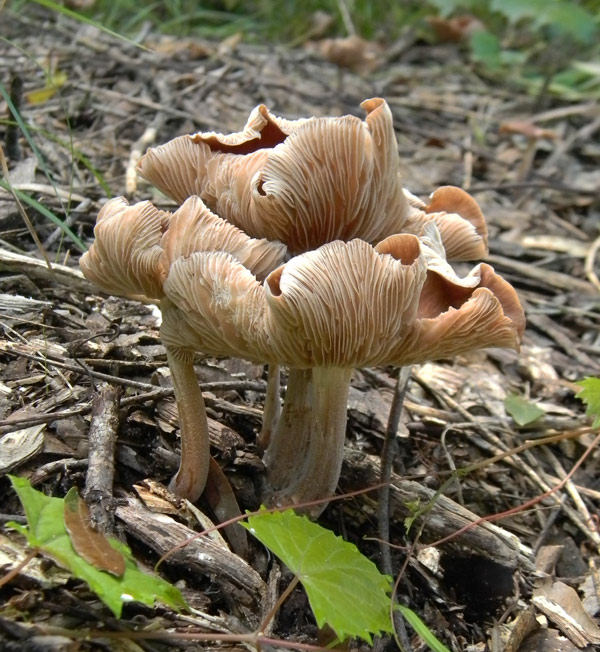
NOT chanterelle mushrooms. The gills are wrong, the texture is wrong and the growth pattern is wrong.
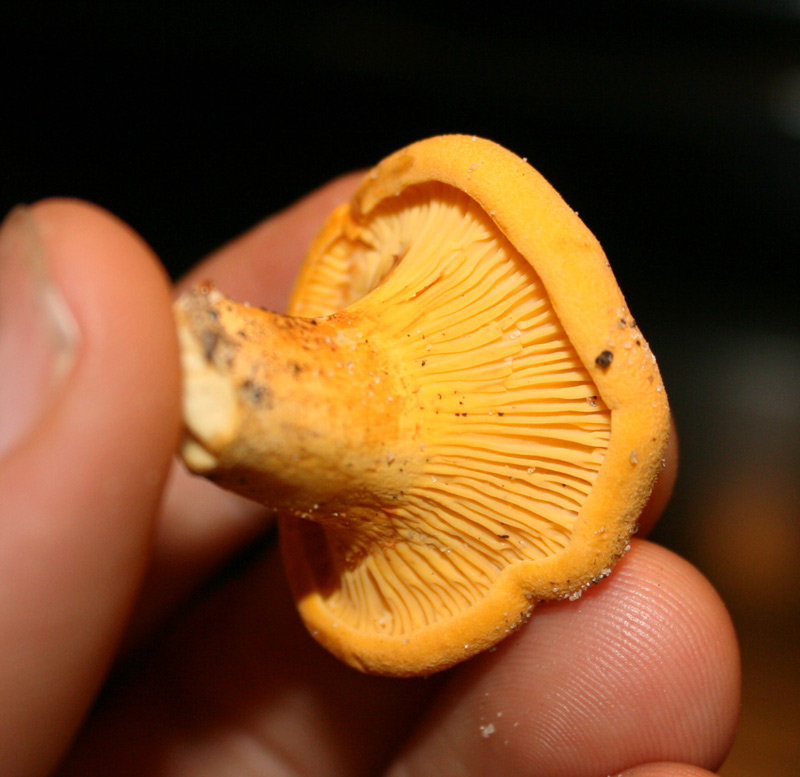
These, for instance, are NOT chanterelles:The giveaway is really the gills. Chanterelles don’t have sharp gills that crumble and break when you run your finger over them. They have folds, instead:
Identify chanterelles once and you’ll have it forever.
Notice how the ridges run down the stem a bit, rather than terminating with the cap. The texture of chanterelles is also firm and non-crumbly.
Here’s a video I just did on identifying chanterelle mushrooms – you’ll see what I mean:
How To Find Chanterelle Mushrooms
Chanterelle mushrooms usually pop up in summer and fall. They grow ONLY near trees, not alone in fields. They also don’t grow in big clumps or on rotting wood. You can’t really grow them at home, so if you find a patch of them, return there year after year to pick more… they’ll be back. I check every week on the patch in our neighborhood.
Note on a chanterelle lookalike: A common chanterelle lookalike is the poisonous Jack O’ Lantern mushroom. You can see that menace here. It definitely looks similar but there are a few dead giveaways. Michael Kuo relates at the link above:
“The Jack O’Lantern mushroom is sometimes confused with chanterelles–especially when it appears to be growing terrestrially rather than from wood (see the top illustration). However, chanterelles rarely grow in dense clusters, and feature false gills, while the Jack O’Lantern is usually clustered and features true gills.”
Yep. All the chanterelles I’ve found have been spaced out here and there around the base of a tree, NOT in clusters or clumps. As I related above, the “gills” are the dead giveaway on chanterelles.
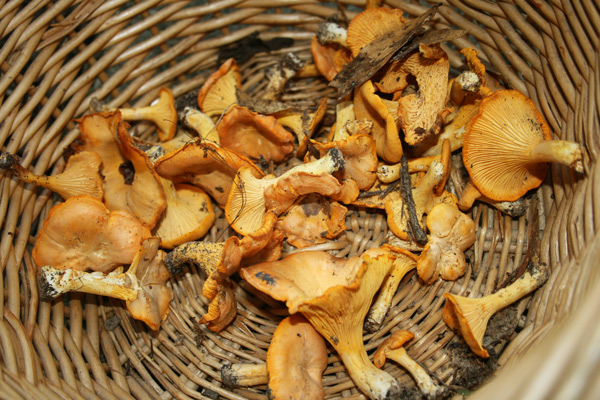
Get your chanterelle ID down and you’ll be picking baskets for the table!
This time of year is a great time to find chanterelles – pick up a good mushroom guide, get out there and get looking. You might be surprised how easy and safe mushroom hunting can be.