 Growing water chestnuts? What ARE water chestnuts? Every once in a while, I come across a crop that’s totally foreign to me as a gardener.
That was the case with water chestnuts until just a few years ago.
I didn’t know they were a sedge, I didn’t know that they were different from the invasive water chestnut, and I couldn’t find any planting stock for testing in Florida.
That is, until my friends at the USDA hooked me up with a few to try out this last winter. I planted them in jars of mud on my windowsill until the weather warmed up outside, then snagged an old bathtub from a family member, put in some potting soil, and planted one in it.
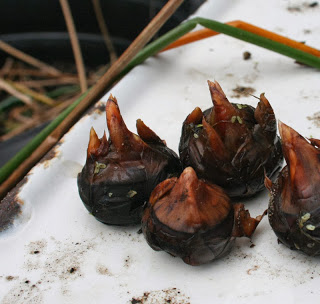
Here’s what I started with:

And here’s what I had a month or two later:

And by July:

These plants grow like mad. When the leaves began dying back and I started pulling them up a few weeks ago, I found I had piles of water chestnuts for eating and planting.

NOTE: How I grew them this last year was not quite correct. First off, I added too much water to the tub and not enough dirt in the bottom. I got a lot of small and squashed corms from this method. Next year, I’m growing them in these bad boys:

Yep. Those are old hot tubs behind my greenhouse. I actually have three now, all of which will be growing food for me this next spring.
Until then, however, I’m keeping some water chestnuts growing in the greenhouse. Here’s how to grow water chestnuts:
Step 1: Find something that holds water.

Step 2: Put some good dirt in it.

Step 3: Plant a water chestnut a few inches deep.

Step 4: Add water until it’s over the soil line.

Growing water chestnuts is totally easy. Just wait – within a few days, that chestnut will pop up. They grow like crazy, as mentioned previously, and the “nuts” will be all over the place beneath the muck in about 6-7 months.
Alternately, you can grow water chestnuts in kiddie pools or swampy areas. For low-work yield, they’re hard to beat. They’re even pretty good nutritionally. Plus… the flavor is superb. Nothing at all like the canned or frozen blah you get with Chinese takeout.
The only downside I’ve found on Chinese water chestnuts is that they’re a pain to process. Peeling the corms takes time!
UPDATE: Check out this rare video of a Yanomami Indian growing water chestnuts in the Amazon:
SPUDOMETER RATING:

4 Spuds
Name: Water chestnuts,Chinese water chestnuts
Latin Name: Eleocharis dulcis
Type: Perennial water sedge
Size: Around 2-5′ tall
Nitrogen Fixer: No
Medicinal: No
Cold-hardy: No
Exposure: Full sun
Part Used: Corms
Propagation: Corms, division
Taste: Excellent
Method of preparation: Raw, cooked, pickled
Storability: Decent. Keep in cold damp sand or can them.
Ease of growing: Easy
Nutrition: Good
Recognizability: Low
Availability: Low


42 comments
Very cool but one concern holding me back on this one… does this create a mosquito breeding habitat? That is the last thing I want…
Good question. I added a natural bacteria to the tub to keep the mosquitoes from taking over – but now I know you don't even need that much water. You can grow them in muck, rather than standing water. Alternately, you could add goldfish to the system.
Where might one purchase some corms? Thanks, David. Good stuff!
E-mail me directly off the link at the top of the sidebar below the newsletter link – I have a few I can send you.
I have been looking to buy corms to grow do u know where to get them?
Do you still have any you can send? I will pay postage or has any one found a source for them?
Drop me an e-mail.
I would definitely keep those suckers in a contained environment for growth. Looks like they could take over in a heartbeat. Any idea if they will they grow in brackish water? Glad to have found you! I am in SW Florida on Sanibel and am converting my entire landscape to edible. Thanks for sharing your knowledge. Peace
David, I'd be interested in the corms as well. Are you still selling them? I'll keep checking this site. Thanks!
If you click through the paypal link I do have the full plants for sale. I'll have corms in the fall – they aren't ready yet.
Do you have any posts about harvesting and shucking the nut? If not, what's the most efficient way you've found? Thanks!
That's the Achille's… root of water chestnuts. I just use a carrot peeler but there has to be a faster way.
What about grating them on a microplane, like one does with zesting a lemon, just to get the outside off?
That would do it. I'll have to try it out – our roots are about ready now.
You still sell these?
Yes, though they're going dormant right now so I'm sending live corms instead of bundled plants. They're great plants.
Can you tell me how they go dormant, and how you store them for winter?
So long as the pond doesn’t freeze, they do great just left alone in the muck. They die back in the fall, then the tops usually go completely brown sometime around frost.
Thank you! :)
Hey David, you got any Corms available?
No, I’m not shipping them anymore since the homestead is up for sale.
I live in California’s Central Valley. Where can I buy Chinese Water Chestnuts for planting? Is it to late to plant?
Try the Asian groceries – they often have them.
Really no REALLY. INDIAN GUY in rainforest where Jersey ! In a kiddy pool
Seriously shopping for water chestnut starts. Amazingly frustrating. It seems you have to have a friend! Can anyone help? Retired chef who knows the delight of fresh water chestnuts avoids the canned ones like the plague. There’s no going back once you’ve tasted the real deal. I’ll thank you in advance with a simple yet elegant recipe for Snow Pea Leaves &Tips. Cut off approximately 6 to 8 inches of snow pea vines at the end. Chop (not crush) garlic and briefly simmer in Sesame Oil (regular oil NOT the toasted version), & remove the garlic. Turn up the heat in your wok add the flavored oil and wok the tips briefly to cook. ( Like most peas, “if you think their done, they’re overcooked!” ). Add the cooked chopped garlic and some warmed, not toasted, sesame seeds and toss & serve immediately. Inspired by Ping Pang Pong at the Gold Coast Casino Las Vegas.
Heh. I don’t have any water chestnuts any more – we sold our homestead, water chestnut ponds included. Try the various permaculture grounds on Meetup. Looks like a great recipe, though.
I’m going to be setting up a plant swap forum on this site for trading plants – will announce that soon. I know some readers have water chestnuts they could share, even if I don’t.
Looking for water chestnuts to plant. Any suggestions on a source? Thanks
I live in Southern California,I have live plant for sale.
Anna, Do you still have live water chestnut plants available to purchase from you? I am seriously interested. I have been searching up north ( WA./OR.) and have not been successful in locating any. Please contact me to let me know if I can purchase any from you. please contact by e-mail: waconverse@yahoo.com
If you had seeds to sell I’d love to get some from you. Sorry, I couldn’t find your email on the site here.
No longer, unfortunately. We moved and sold the farm.
Anyone who has Chinese water chestnut available for sale, please contact me at sweetsensations72802@yahoo.com
I’ve been looking without any luck and would greatly appreciate the chance to plant some.
Does anyone have any links to buy some corms in the EU or France?
I just ordered some from eBay!!
Hello! I was wondering if the colms have to be dry before planting? I know that must seem stupid considering they want to be pretty waterlogged, but I don’t want them to rot if they’re not ready.
Sorry, corms. CURSE YOU AUTOCORRECT.
No, they should stay wet.
Hi..I am really interested in growing water chestnuts (for my own use). I live in South Florida and can’t seem to find any plave in my area that I can get a few corms to start my “water chestnut project”. Can you help…Specifically, I live in Miami. Thanks…
wondering if you still sell corms for the chinese chestnuts or the plants ? I just found your site today and it’s SO interesting ! Thank you – Julie Turpish I live in planting zone 8a :)
Hello I just bought some corms from these folks. just ordered them yesterday. This is the link for them below.
https://azgardens.com/product/chinese-water-chestnut-eleocharis-dulcis-bog-plant/
Good find – thank you.
Comments are closed.