Inside the US, cassava is generally unknown except among some ethnic minorities.
Yet it’s where tapioca comes from (or “fish eyes,” as my Uncle Stuart calls them) and has been used as a source of laundry starch.
The roots are really, really high in starch.
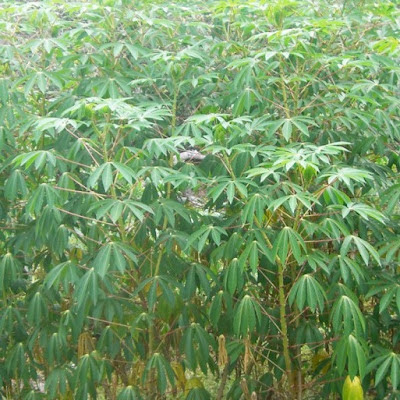
Growing to about 12’ tall, the cassava plant looks very tropical.
Its palmate leaves and graceful cane-like branches are attractive in the landscape or in the garden.
 Cassava’s pseudonyms include yuca (with one “c,” NOT two – “yucca” is a completely unrelated species), manioc, the tapioca plant, and manihot.
In Latin science-speak, it’s Manihot escuelenta.Whatever you call it, it’s a serious staple crop. Virtually pest-free, drought tolerant, loaded with calories, capable of good growth in poor soil – cassava is a must-have anyplace it can grow.And it’s MUCH less work than grain and much more tolerant of harvest times. In fact, once it’s hit maturity, you can basically dig it at any point for a few years (though the roots may sometimes get too woody to eat).
But there is a caveat on cultivation: cassava doesn’t like cold. At all.
If temperatures drop to freezing, your cassava will freeze to the ground.
This won’t usually kill the plant, but it does mean you need to plan your growing accordingly. In the tropics, cassava is a perennial, capable of growing huge roots and living for years.
Here in Florida the plant does well until you get north of zone 10, then the occasional frosts will knock it down. Growing it at any zone beyond 8 is likely an exercise in futility. Cassava needs warm days and nights to make good roots.
And speaking of roots… the cassava’s roots contain roughly twice the calories of a comparable serving of potatoes.
Bonus: they’re easier to grow.
Of course, there is the cyanide to consider.
CYANIDE?!?
What – you didn’t think a plant this awesome could exist without a down side, did you?
Yes – cyanide.
The plant is full of it, from its lovely leaves to its tasty roots. Fortunately, boiling or fermenting gets it out, so fear not.
A lot of plants we eat are poisonous. Just google the “cashew tree” or look up the toxicity of dry kidney beans.
Now THAT’S scary.
Compared to many things we eat, cassava’s pretty tame.
Microwaveable burritos, for instance.
How to Grow Cassava
 Now – moving beyond the cyanide – how do you grow these things?
Unlike many plants, cassava is not usually grown from seeds except for breeding purposes. The only way most folks grow it is via stem cuttings.
(Roots from the grocery store almost definitely won’t work since they’ve been separated from the stem and dipped in wax.)
To grow from fresh cuttings, chop a sturdy stem into pieces about 1.5’ long, stick them in the ground on their sides about two inches down
and cover them lightly with soil – or, as I plant them, stuck in vertically with the growth buds pointing up – and within a week or so they’ll be growing new leaves.
I demonstrate how to plant cassava in this short video:
6-12 months later (depending on care and rainfall), they’ll be ready to start harvesting.
To harvest, machete down the entire plant a foot or so from the ground, throw the branches to the side and start digging.
Be careful, though – the roots are easy to chop through. Some careful exploratory digging with a trowel is often a good idea. The roots you’re looking for grow down and away from  the main stem and are generally located in the first 1-2’ of soil. They’re deep brown with flaky skin. Don’t dig them too long before you’re going to process them as cassava doesn’t store well at all.
Once you harvest the roots, you’ll want to chop up the rest of the plant to make a new set of canes for planting out. I snap off all the leaves and compost them, then cut the bare canes into planting size. Canes that are too green tend to rot rather than root, so throw them on the compost too.
Sturdy, 1-2” diameter canes are perfect.
Plant them a third of their length or so into the ground and stand back so the new growth doesn’t knock you over. Just don’t plant them upside-down.
Ensure they’re right side up by looking for the tiny little growth buds by the leaf bases (or where the leaves were before they hit the compost bin). That little dot should be above the leaf’s base, not below.
Preparing the roots is another post for another day.
Keeping Cassava Alive Through Winter
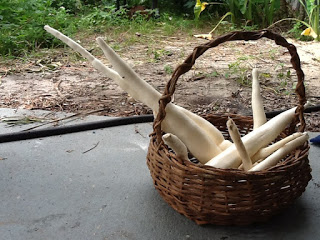
Peeled cassava roots
The Cassava plant is a must-have in warm climates, but even at the edge of its natural range you can push it.
You can bury cut canes in a box beneath the ground for the winter, as a Cuban friend told me her family does… you can let your current plants freeze to the ground and just wait for spring to bring new growth back… you can put cuttings in pots and bring them inside on freezing nights, then plant out in spring… or you can get a greenhouse and always keep a few plants in there for propagative stock.
It’s pretty tough stuff.
Here is how we keep cassava cuttings alive through winter:
And as for work, the worst part is the harvesting. View it like digging for treasure and it’s fun.
Here’s my video on harvesting cassava:
Another great thing about this plant: its leaves are also edible (boiled, of course – remember… CYANIDE!) and rich in nutrients.
The young leaves are best and remind me of a drier-tasting collard green.
Not bad. At harvest time I usually grab a few baskets’ worth for the table or the freezer.
The roots can be chopped and frozen raw as well – they keep quite well that way.
Start learning this plant. It’s literally a lifesaving staple in Africa.