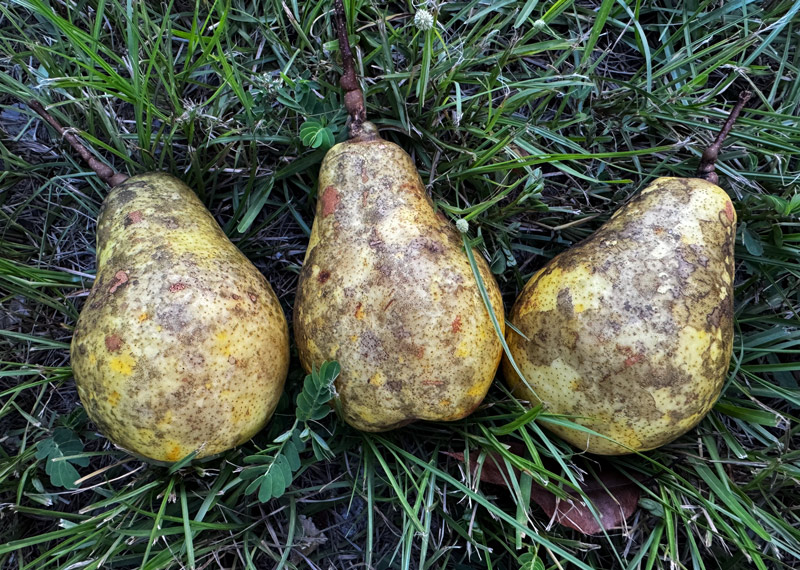
Yesterday I wrote a post on the amazing, precocious, delicious Spalding pear tree growing in our food forest.
After finishing that post, I dug deeper and was able to find a write-up on the original release of the Spalding Pear in 1982. Here it is in its entirety:
‘Spalding’ Pear
J. W. Daniell, R. P. Lane, W. A. Chandler, and Gerard Krewer
University of Georgia, Georgia Station, Experiment, GA 30212
HortScience 17(4):685–686. 1982.
Additional index words: Pyrus communis, Pyrus pyrifolia, fruit breeding
‘Spalding’ pear (Pyrus sp. Nak) has been released to provide a good quality pear cultivar for home planting in the Piedmont area of the southeast where fire blight is a major problem.
Origin
‘Spalding’ is a seedling selected from residual material of a pear breeding project which existed in the 1920s at the Georgia Experiment Station. Parentage is unknown, although one parent is probably ‘Pineapple’ (1). Thus, ‘Spalding’ is derived from at least 2 species, Pyrus communis L. and Pyrus pyrifolia (Burm.) Nak.
Description
‘Spalding’ is a vigorous tree (Table 1) with a central leader and open branching. Branches are somewhat drooping toward the distal ends. Tree size is similar to that of ‘Magness’. Leaves are broad ovate with serrate margin, rounded base, and acute apex. The length to width ratio is 1.4. The flowers are self-fertile. This cultivar is productive and has cropped consistently well in trials for 24 years at Experiment.
‘Spalding’ has a good level of field resistance to fire blight incited by Erwinia amylovora (Burr.) Winslow et al if grown under a low-fertility program. Under a high-fertility program, ‘Spalding’ along with ‘Old Home’ blighted in 1934, a year that fire blight was unusually severe. Resistance to leaf spot incited by Fabraea maculata (Lev.) Atk. is good, similar to that of ‘Bartlett’ (Table 1).
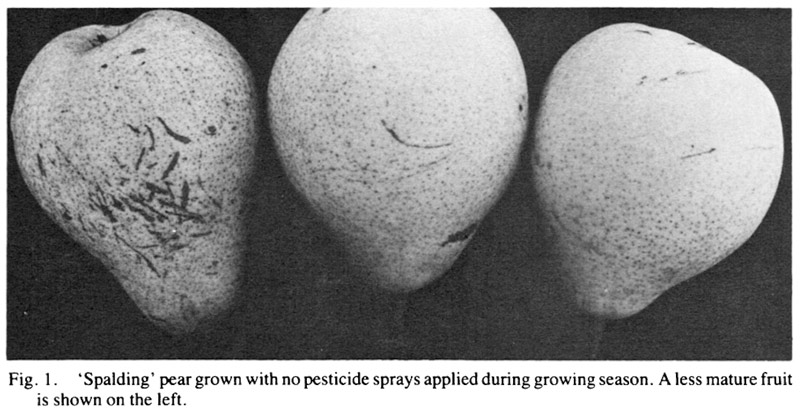
Fruit of ‘Spalding’ is large (Table 1), round-pyriform in shape, averaging 77 mm in length and 73 mm in width. It is very smooth with a regular contour (Fig. 1) and small cavity. The stem is thin and of medium length. The basin is broad, shallow and sloping. Calyx is persistent and closed. External color is yellow, lightly russet with brown dots, and has no blush. Flesh is creamy white, finely textured but not buttery, and juicy with grit cells present only around the core. Flavor is good, being subacid and having a light aroma. The full-bloom dates have varied from March 18 to March 24, and the average ripening date has been August 5 at Experiment, Ga (Table 1).
Table 1. Characteristics of 6 pear cultivars, Experiment, Ga., 1957–80
Ratings are based on a scale of 1 (undesirable) to 10 (most desirable).
| Cultivar | Plant vigor | Dates of full-bloom | Avg. ripening date | Fruit size | Fruit quality | Fire blight resistance | Leaf spot resistance |
|---|---|---|---|---|---|---|---|
| Bartlett | — | — | — | — | — | 1.0 | 9.4 |
| Kieffer | 8.7 | Feb. 17–Mar. 18 | Sept. 3 | 10 | 6.0 | 8.2 | 8.2 |
| Magness | 8.6 | Mar. 25–Apr. 1 | Aug. 1 | 7 | 9.2 | 9.0 | 9.5 |
| Old Home | 8.6 | Mar. 31–Apr. 4 | Sept. 4 | 6 | 5.0 | 9.9 | 9.5 |
| Orient | 8.6 | Mar. 8–Apr. 8 | Aug. 9 | 10 | 8.1 | 10.0 | 9.3 |
| Spalding | 8.6 | Mar. 18–Mar. 24 | Aug. 5 | 8 | 8.7 | 9.6 | 9.4 |
Table notes:
- Dates of full bloom are the earliest and latest blooming dates during this test.
- Comparative fruit size: 5 = medium to 10 = large.
- Fire blight resistance based on blossom and shoot evaluation.
- All Bartlett trees were dead from fire blight by the 6th year.
Figure 1
Availability
A limited amount is available from the Department of Horticulture, Georgia Station, Experiment, GA 30212.
Literature Cited
- Woodroof, J. G. 1923. The Pineapple pear. Ga. Expt. Sta. Bul. 142.
Publication note
Received for publication Feb. 24, 1982.
The cost of publishing this paper was defrayed in part by the payment of page charges. Under postal regulations, this paper therefore must be hereby marked advertisement solely to indicate this fact.
W. A. Chandler was Associate Professor, Department of Horticulture, and Assistant Professor, Department of Plant Pathology, respectively.
Gerard Krewer was Graduate Assistant, Department of Horticulture.
Takeaway
Spalding whipped Kieffer on fruit quality, which is not surprising. Kieffer is a very easy-to-grow pear that has become a backyard staple in the Deep South, but it’s only mildly sweet, with crunchy, almost fibrous flesh and a tough, bitter skin.
Spalding also is a good replacement for Bartlett, which is the standard grocery store pear. As the study relates, “All Bartlett trees were dead from fire blight by the 6th year.” Not a good track record!
Spalding also has large fruit, comparing well with other pears. Though our tree is still small, the fruit was of good size.
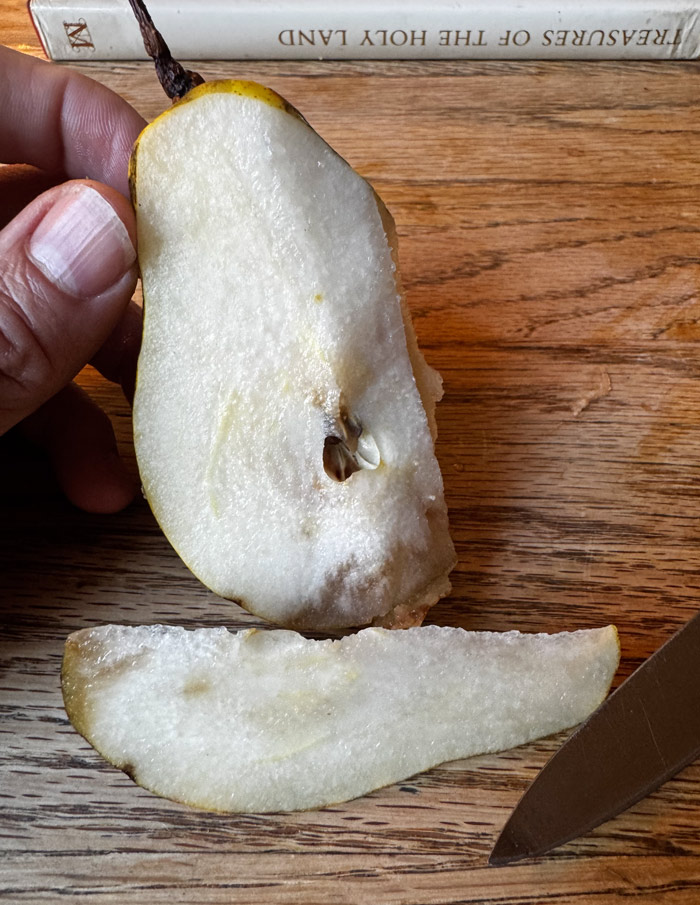
There are not many disease-resistant dessert pears that thrive in the South. Our tree doesn’t even have spots on its leaves right now, despite the heat, humidity and rains of this year. Many of our other pears do.
This is an interesting note as well: ‘Spalding’ has a good level of field resistance to fire blight incited by Erwinia amylovora (Burr.) Winslow et al if grown under a low-fertility program. Under a high-fertility program, ‘Spalding’ along with ‘Old Home’ blighted in 1934, a year that fire blight was unusually severe.”
Low fertility = normal backyard growing conditions. The article also notes that the pears in Figure 1 were grown with “no pesticide sprays applied during (the) growing season.”
If you gave them high fertility, they could get fire blight. But if you didn’t, and didn’t bother spraying them, they gave you fruit without issue. Sounds like a perfect backyard tree.
Another interesting thing about the Spalding is that it appears to be quite precocious. Chathamapples.com has a write-up on this pear (among other varieties), noting it is:
Very precocious; on OHxF#51 rootstock, all three trees bloomed in their 2nd year and fruited in their 3rd year. Fruiting was delayed by one year when grafted onto calleryana rootstock. Productivity: Very productive, definitely one of the most productive pears I’ve grown. Bears annually. Somewhat self-pollinizing and a good pollinizer for other cultivars with an overlapping bloom season.
The author also claims the:
Flavor is bland, slightly sweet with little acidity, but a nice perfume. In my opinion, they are better if eaten a bit firm because the crunch adds some interest to the eating experience. The fruits are juicy. Texture is smooth and the skin is thin. There are almost no grit cells in the flesh and when they are present, they are so near the small core that one rarely encounters them.
Ours were quite sweet, however, so there may be some variation according to soil.
We plan to graft and carry Saplding in our nursery in the future. It will take a while to get production going, since we have very limited grafting material. It also takes over a year to get a pear to a good size from a graft, but we’re on it now. This variety needs to take off.
You can read more about our tree in yesterday’s post.

3 comments
Question for you that isn’t related to pears, but related to Steve Solomon and his COF.
I wanted to use my weed water this year, but I got stuck at wondering if using that alongside my side-dressing with Steve’s COF (the stuff I buy off the web that is comparable to his COF ingredients) – if that would be too much?
What do you think? Do you use your weed water instead of COF/fertilizer, or do you think it’s OK to use both?
I live in Zone 5a, if that makes a difference to useage.
Thank you!
I think the swamp water/weed water would be fine to use alongside it. It’s not usually very strong, and is good for fertigation.
OK, thanks!
Comments are closed.