
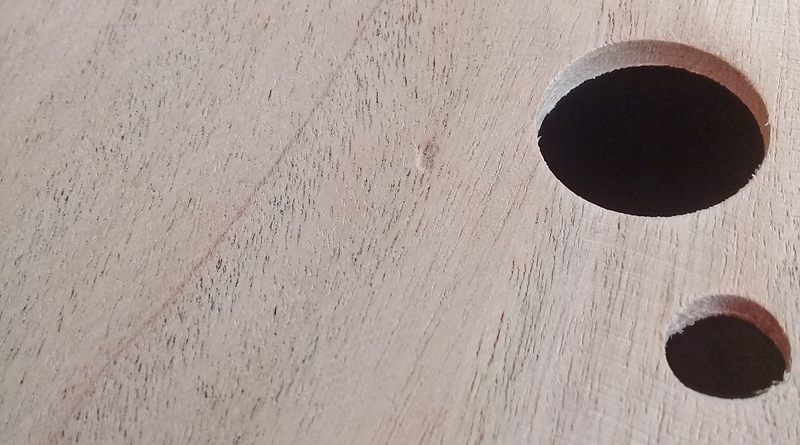
Identifying mahogany is a little harder than it might seem at first glance. If you’ve ever wondered if you have real mahogany, this article at the Wood Database is eye-opening:
“So you’ve just stumbled across some sort of “mahogany” wood, and you’re wondering if you have the real deal. After all, there are currently over a half dozen types of mahogany listed on The Wood Database. Much like cedar, the “mahogany” label gets tossed around with relative liberality—and not always with regard to the botanical designation of the wood in question. Ultimately, the ambiguous term mahogany remains somewhat subjective. But regardless of where anyone happens to draw the line on what is and is not true mahogany, certain facts and scientific classifications of the trees remain constant, and a general consensus can at least be made on the objective facts surrounding these woods.
But before we sort everything out, it would be helpful to ask a needed question: why? Why bother trying to sort things out? If it looks like mahogany, what’s the difference anyhow? A lot, it turns out. Beyond simply being worth more in terms of dollars per board-foot, there are practical implications to using true mahogany.”
When I was a kid in Fort Lauderdale, my grandpa had a beautiful mahogany tree growing next to his carport/wood workshop. So far as I know, it’s still there. My bet is that it was the true “Cuban Mahogany” of legend, as the tree was likely planted in the 1950s.
There are old mahogany trees scattered here and there around South Florida. This one is growing a few blocks from my parents’ home in Fort Lauderdale:
Where I live now there are still quite a few mahogany trees, but international restrictions keep them from being harvested and sent to the US. I looked into sending some lumber to my brother and it seems that getting a permit is beyond me.
I can, however, use the boards myself. Here’s a little three-string guitar I’m building from a calabash gourd and some local mahogany.
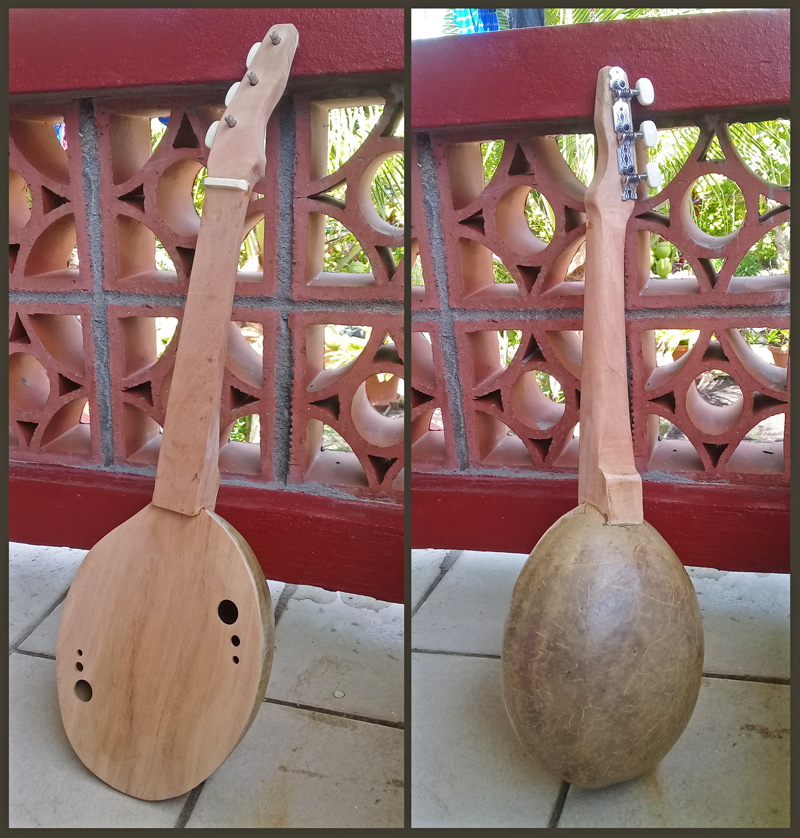
The neck and top are mahogany. Note how light the wood is compared to the dark red-brown we normally associate with mahogany. The wood is more variable than one might think. It’s also a joy to work. Light, strong, easy to carve. I love it.
Here’s a close-up of the top so you can see the grain:
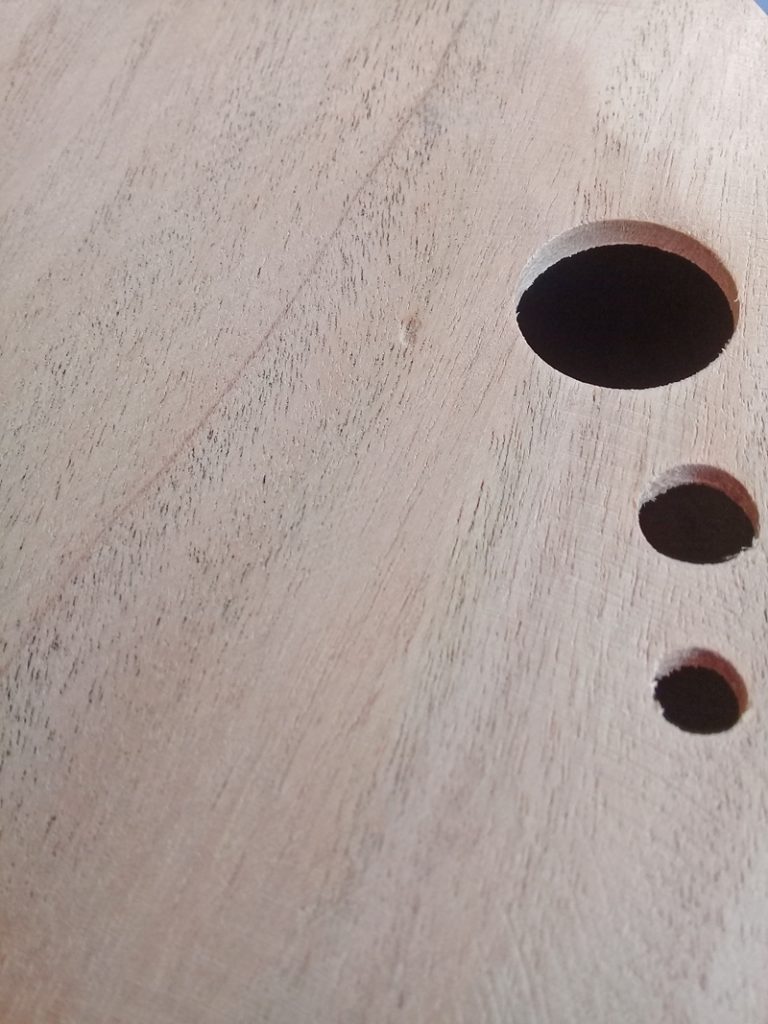
As you can see, I haven’t finished the wood yet. There is more sanding to do, but I’ll get there soon.
Real mahogany is a joy to work. I saved some broken pieces of mahogany furniture from the old house on the lot where we garden and I’ve been using those pieces for little projects as well. The older wood is dark and dry and very easy to shape.
When we get land, I’ll have to plant a mahogany tree in memory of Grandpa.

6 comments
Looks interesting, like a bowlback mandolin. How do you determine size and placement of the sound holes?
Guessing, really.
I had the cabinet maker use mahogany for all the cabinets in my house. They are beautiful. When he brought samples for me to look at he pulled out the mahogany last. I swear it had a heavenly glow. I ended up having to postpone the build for three months so that I could have time to save up the extra money. Well worth the wait and the money. Even now, ten years later I look at these cabinets and think they are the most beautiful things in my house.
Neat little…guitarlin?…mandotar?, well whatever, looks good.
Interesting article you linked. Some of the substitute woods looked pretty good in their own right. Some years ago I bought the wife a bedside table from an antique store & the saleslady said it was mahogany. I assumed that was nonsense but maybe…
And now I have to hop on my hobbyhorse & ask: How are you going to finish it?
I’m a little obsessed with finishes at the moment, especially traditional ones, so forgive me.
One basic formula I keep running into (for instruments) is: resin (mastic, e.g.), linseed oil, & turpentine.
You said mahogany is lighter than we think of. Oh yeah. But also, mahogany darkens over time. It’s not the stain that darkens, but the wood itself. If you repair or match older pieces, it’s tricky, because you can match it today, but 20 years later the repair is darker than it was and will no longer match. My guess is that’s why the convention is to stain mahogany really dark – so later repairs and replacements to sets are possible. (Cuban mahogany is darker than what is available now, but when I’ve refinished older things, they come out noticeably lighter, just from lifting finish with acetone or alcohol, no sanding off the top layer, and tend to have dark stain that lifts with the finish.)
Good idea. It is amazing how wood color changes. People love purple heart… but keeping that purple is like grasping the wind!
Comments are closed.