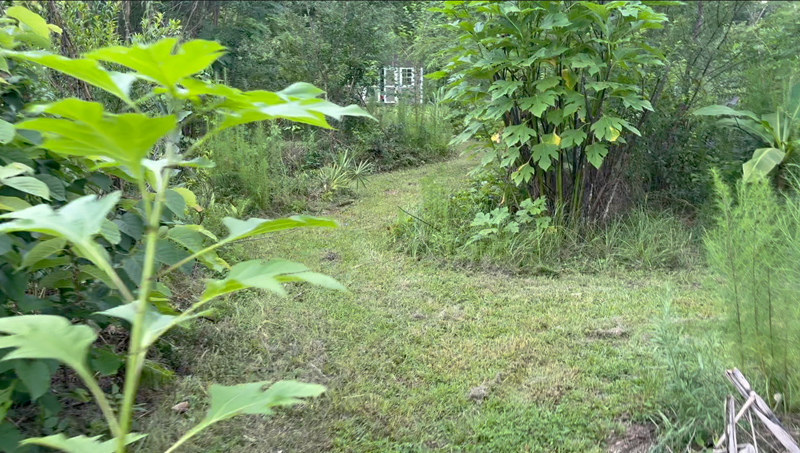
Last week I recorded a chop-and-drop video, sharing how we use weeds like goldenrod, mimosa trees and wild mint as free, renewable mulch and compost for the soil. Our food forest is not our main garden so we don’t do much with the herbaceous layer, concentrating instead on the long-term canopy and sub-canopy and just chop-and-dropping the various volunteers.
I finished reading The Home-Scale Forest Garden by Dani Baker a week ago and have to share a quote that really resonated:
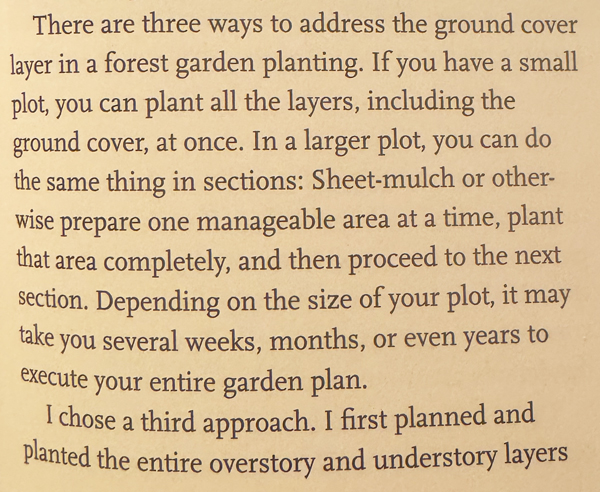
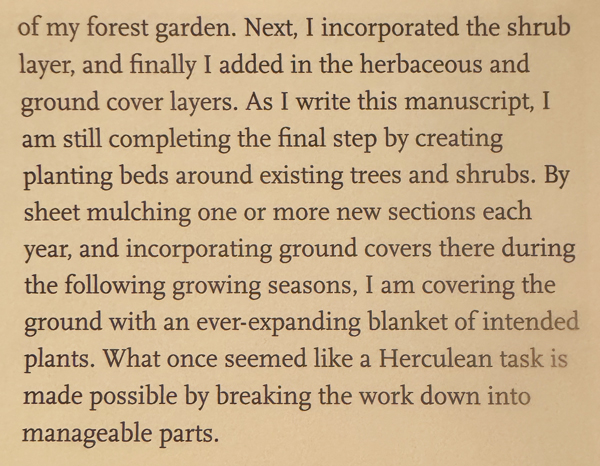
“There are three ways to address the ground cover layer in a forest garden planting. If you have a small plot, you can plant all the layers, including the ground cover, at once. In a larger plot, you can do the same thing in sections: Sheet-mulch or otherwise prepare one manageable area at a time, plant that area completely, and then proceed to the next section. Depending on the size of your plot, it may take you several weeks, months, or even years to execute your entire garden plan.
I chose a third approach. I first planned and planted the entire overstory and understory layers of my forest garden. Next, I incorporated the shrub layer, and finally I added in the herbaceous and ground cover layers. As I write this manuscript, I am still completing the final step by creating planting beds around existing trees and shrubs. By sheet mulching one or more new sections each year, and incorporating ground covers there during the following growing seasons, I am covering the ground with an ever-expanding blanket of intended plants. What once seemed like a Herculean task is made possible by breaking the work down into manageable parts.”
We do this as well.
When we have time, we sheet mulch an area to eliminate weeds, then plant smaller plants beneath the growing trees and shrubs.
Someone asked in the video comments if my garden was really making food… or just a mess.
It’s a good question, so yesterday I posted a follow-up video showing the wide range of edible plants in the food forest.
If you want more food in the early years of a food forest, the solution is simple.
Dig garden beds, sheet mulch and plant sweet potatoes, run beans and pumpkins and melons on the ground, throw in beds of salad, plant tomatoes – basically, just create fast-growing short-lived food gardens around the trees and shrubs.
But if you don’t need the food or don’t have time for that, concentrate on getting the “tent poles” of the system in place. Nut and fruit trees, berries and perennials with edible leaves, fruits or roots.
That’s where we are now. It’s three years in, and we have plums, pears, pawpaw, citrus, beef and onion tree, blueberries, blackberries, hazelnuts, chestnuts, true yams, Japanese persimmons, pineapple guavas, loquat and other long-term canopy and sub-canopy plants reaching for the sky. Over time, they’ll come into heavier production and bring us hundreds of pounds of food.
Right now, if the question is “is this food forest or mess forest,” the answer is… both!
The weeds fill in where we don’t, fixing nitrogen and mining minerals, providing us with compost and mulch for the trees they surround.
If you have a tiny space, you can create a very productive mini food-forest by planting a tree, a few shrubs, some herbs, vegetables, and a sweet-potato ground cover. If you have a big space and don’t need to manage it for maximum production, just concentrate on your canopy and sub-canopy trees and shrubs, then keep them happy while knocking down the weeds as they grow. Over time, even that less managed space will become productive.
Think of it like this:
MORE TIME & EFFORT: Lots of Food Now/Lots of Food Later
LESS TIME & EFFORT: Little Food Now/Lots of Food Later
Either way, you’re going to get plenty of food as the system matures.
If you want to see how I plan out a food forest and create it with way less work that you would think, sign up for my Skool Group here and check out my complete food forest video course.
Or, if you’re in Zones 8-11, get a copy of Create Your Own Florida Food Forest.
Or if you’re really cheap, just watch my videos. We’ve shared a lot on our food forests over the years.
