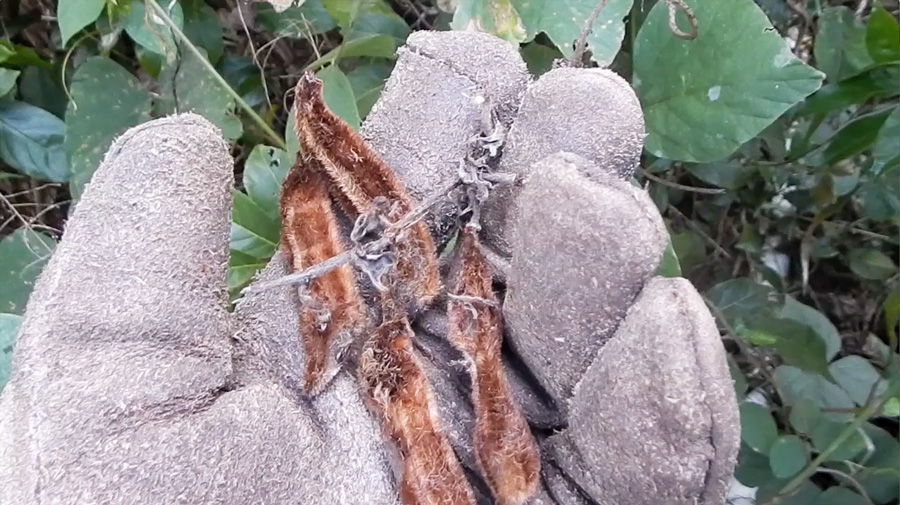
We’ve been growing velvet beans (Mucuna pruriens var. utilis) since our old food forest back in Florida; however, I didn’t come in contact with the “madness bean” version – the wild, brutally stinging type of Mucuna pruriens – until we lived on the island of Grenada.
The wild form is also known as “cowitch,” and will drive you mad.
Our Encounter with Madness Beans
Derek Clawson’s comment the other day reminded me of my experience with the “madness bean.”
“I did grow the itchy type once … Never ever do that if you haven’t! It produced buckets of pods but the fibers were almost impossible not to get all over you. It was a nightmare cleaning up that vine from a fence. It itches so badly for 30 plus mins you’ll itch your skin off trying to satisfy the irritation. Absolute hell. When some guy had originally sent the seeds he warned me I’d never grow it again but I thought it couldn’t be that bad. It’s that bad and I never grew it again.”
Back in 2017 I was told by my friend Mike who lived up the road on the island that there was a patch of stinging beans in one of the fields at a lower altitude, so I hiked down there to get some:
I thought we could use them medicinally, like we had done with our cultivated varieties in the past.
Yet after filming that video, my arms itched and stung for more than a day, and that was just from the little hairs that drifted off the pods I harvested! We never did do anything with those pods. I didn’t want to touch them again, even with gloves.
The pain was tormenting, and nothing seems to take that sting out.
Cultivated vs. Wild Mucuna pruriens
The cultivated form of the madness bean (Mucuna pruriens var. utilis) is still medicinal, as well as being an excellent cover crop and nitrogen fixer, and it lacks almost all of the stinging hairs. The pods will sometimes make you a little itchy, but it’s nothing like the torment of its uncultivated relations.
This spring I plan to plant a large section of the cultivated variety of velvet beans so we can harvest seed and perhaps offer it for sale. It’s hard to find in the US, and is expensive when you can find it. We’ll use it as a suppressive ground cover in the food forest to build the soil and kill off the grass while adding nitrogen, then see how much seed we end up with.
Grow the right type and it’s a very useful plant. Grow the wild type and it’s a devil. The only place I would ever deliberately plant the wild stinging form is at the edge of a property to deter trespassers. Otherwise, it’s just too dangerous.
Happy Monday!

8 comments
I didn’t know there was a cultivated type of cowitch. I grew up in Jamaica where we have the wild type. I’d like to grow the cultivated type to treat my husbands Parkinsons.
Where are you located now, Valerie – inside the US?
I grew up in Jamaica, too! And yes these are horrible if you get into them.
The itchy type is horrid for sure. When I had the fence full of them my dog once went running through the vines and then into our bed…what a pleasant experience or not. The only one thing I could think of to help remove them from the fence without as much contact with flying hairs was to hose the pods down really well. It helps a lot but doesn’t entirely contain the madness regardless. They were extremely good sellers online. I had like 5 ten gallon buckets of pods. I took a huge lots of them into another bucket with a lid and shook the heck outta it and let the hairs settle before opening. Then with thick gloves pop the pods open carefully with as little disturbance as possible to get the seeds. Still very hard to deal with but it brought in some cash. The remaining pods I had when I moved I dumped into a drainage canal across the street behind my aunts house in the bushes along the ditch lol…if those that live along the ditch were blessed maybe they didn’t grow and thrive but I suppose they might have. Hopefully I didn’t create a kudzu like mass of itchy velvet bean stands back there. If so it’s the county’s problem now.
I am going to be planting Mucuna pruriens var. utilis to eradicate the cogon grass growing in my bahia grass pastures.
Good luck! I would love to hear if it works.
Hi David! I would love to learn from you how to plant these in north FL, Lake City. I have been using the processed powder as a natural treatment and it has been a year that it has been working. Now I wanted to plant it and produce my own. Is there a video or you can briefly share with us how to do that in am easy way? I would be forever grateful! God bless!
Just plant the beans near a trellis after all danger of frost. They are not cold-hardy at all.
Comments are closed.