Dylan asks about food forest spacing:
“I have (a) question … about the permaculture food forest concept. How do you address the spacing issues? I don’t mean traditional spacing like planting 20 rows of corn at 16 inches apart and in rows 2-3 feet apart blah blah blah, but how do you make sure that you aren’t putting a plant out all by itself or vice-versa not having one plant shadow out the smaller bushes and shrubs and things like that?”
My answer on food forest spacing
That is a huge question.
Here is a picture of part of my previous food forest:
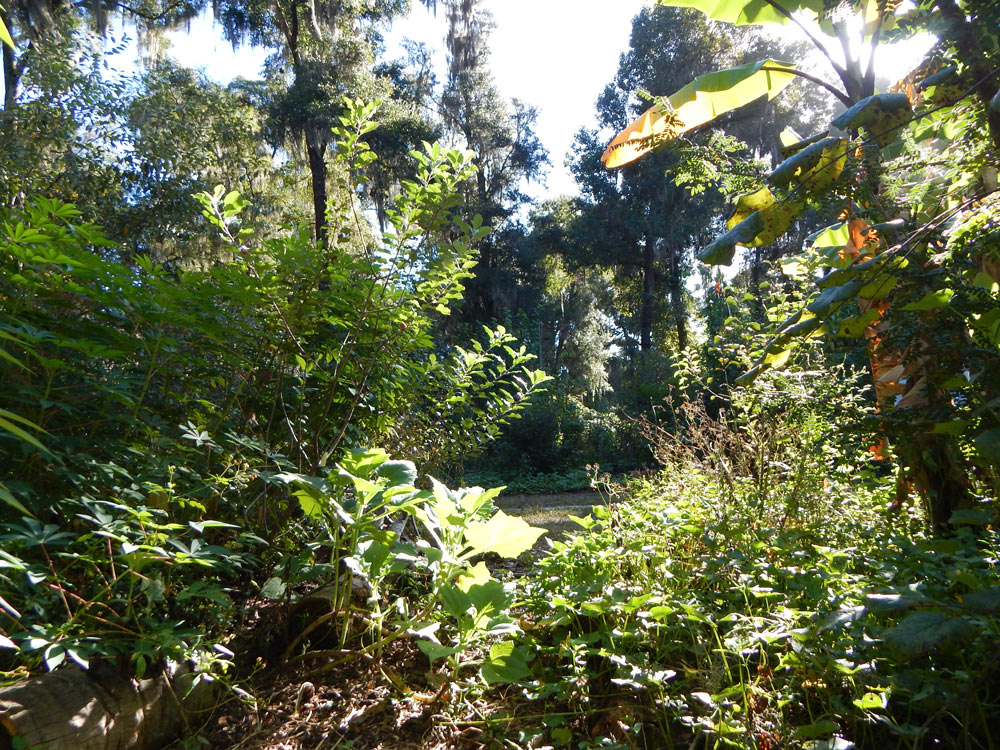
There is a lot going on there!
Generally, I like to fill up the space with a bunch of nitrogen-fixing and biomass-producing species. I make sure that the large trees that you cannot keep cropped back, such as pecans, are placed towards edges will they will not shade everything else.
I tend to start a lot of trees from seed and cuttings and plant more densely than the final food forest will be.
Know this: you can prune and bend the living daylights out of many fruit trees and keep them from overcoming the space. Plant a lot more, then clear later as the need arises.
Nature will evolve a system.

No, not like that.
No new species are likely to spontaneously generate in your food forest.
However, species will arrive.
Weeds, insects, birds, reptiles…
Things start to get exciting after a while as systems and checks and balances arrive.
Your initial biomass plants can be chopped and dropped to feed the trees you really love and want to produce food for you in the future.
In my book Create Your Own Florida Food Forest, I argue the value of a small plant nursery area. When you are spending big money on trees and shrubs, it’s hard to cut them down and you worry too much.
You can create 100 fig trees in one weekend via cuttings.
Or a flat of honey locust.
Or you can stick cuttings of Mexican sunflower and cassava all over the place.
Even starting your own peaches from seed is easy.
I let wild trees pop up wherever they like. Some can be grafted, others can be used for trellises, you can feed them to other trees by chopping them down or you can use the wood in your rocket stove. Food forest spacing isn’t a big deal. Just watch those un-prunable trees.
Planning is fine. Over-planning may mean you never end up with a food forest.
Nature is malleable – get out there and get planting.
No fear.

3 comments
I have noticed you can often do groupings of 2 or 3 sometimes even four with the moddle cut out of fruit trees if your limited on space. Year round light pruning to me is best amd easisest taking cuttings when you want. Also wanted to add aethod for dwarf pruning i have been using. You trim back 1/2 the branches right before spring and yearly alternate the branches ie each and every branch is prunned at a 2 year interval. That reduces stress, helps w productions, and keeps growth in check.
Hi David.
I have read a couple of your books on Food Forest and Pushing the Zone, I really learn a lot from them. I want to push the zone in Orlando FL (zone 9b) to grow tropical fruit trees. Live oak trees are excellent canopy layer during the winter to protect small tropical trees/shrubs from frost/freeze because they are evergreen trees. I also like the idea of having some pecan trees for canopy layer because they bear edible nuts. However, I heard that pecan trees are deciduous. i’m not sure how they can protect smaller trees and shrubs from the frost/freeze during the winter when they don’t have leaves on them. would you please advise? Thanks in advance.
Even the bare branches help some with frost protection, but not as good as the oaks. On the flip side, pecans cast less shade overall and don’t spread sideways nearly as much.
The easiest thing to do is to plant the stuff that grows best in your area and needs little to no protection. Like loquats, persimmons, peaches, plums, blueberries, etc.
Comments are closed.