I quit eating almost all grain some years back. I used to have heartburn, sore joints and lethargy during the day – not to mention a gut – and then I discovered the “paleo diet” thanks to this guy and his book.
I lost thirty pounds in about a month and a half, gained muscle, and so long as I stick somewhat close to the diet, I never get heartburn anymore. It’s truly amazing.
But… today we’ll throw that all out because we “Good Gardeners” love all plants, even the ones that make us fat, dull-witted and dyspeptic.
And because growing and utilizing grains really is a marvelous challenge and a link to the past.
In Touch with the Past
Rye… barley… wheat… corn… these are the storable foods that built great civilizations.
Joseph stored away bushels of wheat for Pharaoh in Egypt as he prepared for famine:
“Joseph was thirty years old when he entered the service of Pharaoh king of Egypt. And Joseph went out from the presence of Pharaoh and went through all the land of Egypt. 47 During the seven plentiful years the earth produced abundantly, 48 and he gathered up all the food of these seven years, which occurred in the land of Egypt, and put the food in the cities. He put in every city the food from the fields around it. 49 And Joseph stored up grain in great abundance, like the sand of the sea, until he ceased to measure it, for it could not be measured.
(…)
53 The seven years of plenty that occurred in the land of Egypt came to an end, 54 and the seven years of famine began to come, as Joseph had said. There was famine in all lands, but in all the land of Egypt there was bread. 55 When all the land of Egypt was famished, the people cried to Pharaoh for bread. Pharaoh said to all the Egyptians, “Go to Joseph. What he says to you, do.”
56 So when the famine had spread over all the land, Joseph opened all the storehouses[h] and sold to the Egyptians, for the famine was severe in the land of Egypt. 57 Moreover, all the earth came to Egypt to Joseph to buy grain, because the famine was severe over all the earth.“
A much nastier tale relates to the deities of corn in Aztec culture:
“The fourth month of the Aztec calendar called Huei Tozoztli (“the Big Sleep”) was dedicated to the maize gods Centeotl and Chicomecoátl. Different ceremonies dedicated to green maize and grass took place in this month, which began around April 30th. To honor the maize gods, people carried out self-sacrifices through blood-letting rituals, and sprinkling their houses with blood. Furthermore, young women adorned themselves with necklaces of corn seeds. Maize ears and seeds were brought back from the field, the former placed in front of the gods’ images, whereas the latter were stored for planting in the next season.
As the son of the earth goddess Toci, Centeotl was also worshipped during the 11th month of Ochpaniztli, which begins September 27th on our calendar, and along with Chicomecoati and Xilonen. During this month, a woman was sacrificed and her skin was used to make a mask for Centeotl’s priest.”
Let’s call that reason #182993829 why we should be glad Christian missionaries traveled around the globe.
On a lighter note, don’t forget the marvelous uses of barley:
“Now the grain of the barley is mostly starch, but before the barley can grow this starch must be turned by chemicals called enzymes into sugar. The malster and brewer take the starch of barley, turn it into sugar, and then ‘ferment’ this sugar (as eating it with yeast is called) into alcohol.”
And we call the final product… BEER!
Small-Scale Grain Raising
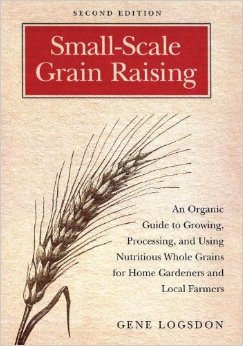 Gene Logsdon’s book makes grains interesting for the home gardener, not just for the big factory farms that grow almost all of the wheat, corn, rice and other grains most of us use on a daily basis. I own the book and have planted patches of rye, corn, barley, wheat, amaranth, buckwheat and even sorghum.
As the description states:
“More and more Americans are seeking out locally grown foods, yet one of the real stumbling blocks to their efforts has been finding local sources for grains, which are grown mainly on large, distant corporate farms. At the same time, commodity prices for grains—and the products made from them—have skyrocketed due to rising energy costs and increased demand. In this book, Gene Logsdon proves that anyone who has access to a large garden or small farm can (and should) think outside the agribusiness box and learn to grow healthy whole grains or beans—the base of our culinary food pyramid—alongside their fruits and vegetables.
Starting from the simple but revolutionary concept of the garden “pancake patch,” Logsdon opens up our eyes to a whole world of plants that we wrongly assume only the agricultural “big boys” can grow. He succinctly covers all the basics, from planting and dealing with pests, weeds, and diseases to harvesting, processing, storing, and using whole grains. There are even a few recipes sprinkled throughout, along with more than a little wit and wisdom.”
Small-Scale Grain Raising is quite a good book and well-illustrated. I quite enjoyed the read and the ideas.

3 comments
Dear David, Rachel and fellow goodies, I found a great resource for companion plant groupings for setting up guilds in your permaculture landscapes. The most interesting thing I found was how Giant Orange Anarynth protects Bolivian Cucumber (Achocha) and Cossinia Grandis (Ivy Gourd) from cucumber beetles by sacrifice. I am planning on putting this to a test as well as using the very tall amaranth stalks as climbing frames. The link is here: http://www.rexresearch.com/agro/comp1.htm
Hey Fred, thanks for the great link!
You are most welcome. :)
Comments are closed.